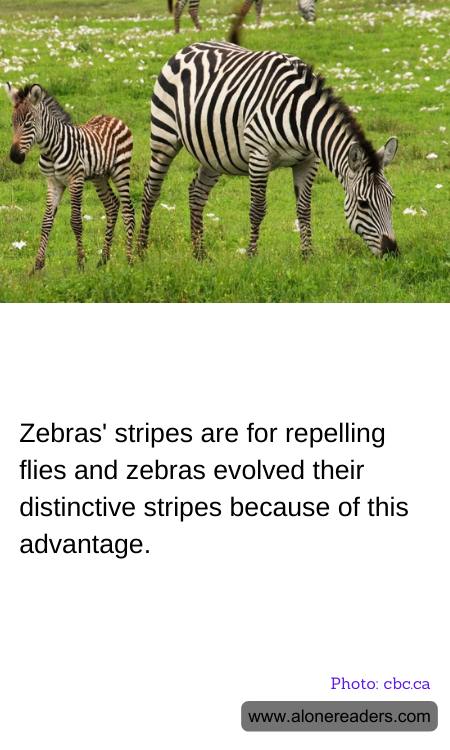
Zebras are among the most recognizable animals on earth, thanks to their distinctive black and white stripes. For years, scientists have debated the purpose behind these unique patterns, proposing theories that range from camouflage to social interaction. However, one of the more compelling explanations backed by research suggests that these stripes serve as a deterrent to biting flies, including horseflies and tsetse flies, which are prevalent in the zebras' natural habitats.
The idea that zebra stripes might repel flies dates back to the early 20th century but has gained significant scientific backing in recent decades. Studies show that the stripes may confuse the visual systems of these flies, which are highly sensitive to linear polarized light. The pattern of the stripes disrupts this polarization, making it difficult for the flies to land precisely on the zebra’s skin. This is a crucial evolutionary advantage as these insects can be carriers of diseases and cause considerable irritation and blood loss.
Further evidence supporting this theory includes experimental studies where researchers have observed that fewer flies land on objects with stripe patterns compared to those with uniform colors. Additionally, the effect of stripes in repelling flies appears to be more pronounced during the times of day when zebras are most active and when flies are most numerous, suggesting an adaptive significance to the striping pattern.
Comparisons with other species of equids support the fly-repelling stripe hypothesis as well. Horses and donkeys, which do not have stripes, are more susceptible to fly attacks than zebras. This differentiation in susceptibility is particularly stark in regions where both zebras and other equids coexist.
Despite this, not all experts are entirely convinced, pointing out that the evolutionary pressure from fly annoyance alone might not be sufficient to explain such a striking adaptation. They argue that if repelling flies were the only benefit, similar striping might be observed in other species facing the same challenges. Thus, it's plausible that the zebra's stripes serve multiple functional roles beyond just deterring pests—such as camouflage in tall grass and a method of heat management, or even social functions within zebra communities.
In conclusion, while the debate is not entirely settled, the evidence strongly supports the notion that the evolution of zebra stripes might have been significantly influenced by the need to deter biting flies. Whether this is the sole purpose of their stripes or just one of several benefits, it represents a fascinating example of how evolution shapes the natural world in sometimes unexpected ways.
