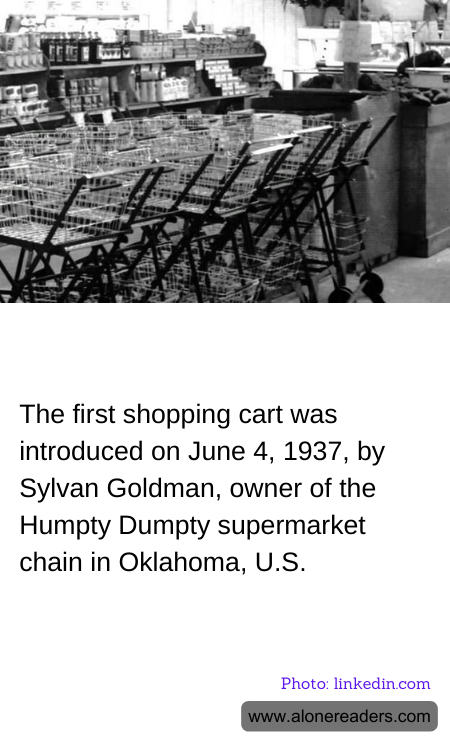
The shopping cart, an indispensable tool in supermarkets and stores globally, was introduced on June 4, 1937, by Sylvan Goldman, the owner of the Humpty Dumpty supermarket chain based in Oklahoma, USA. This invention was driven by a simple yet profound realization: if customers could carry more items effortlessly, they would likely buy more. Goldman, who was constantly looking for innovative ways to enhance shopping efficiency and boost sales, capitalized on this idea by creating a cart that could facilitate easier and larger purchases.
Initially, the shopping cart did not resemble the versions we see today. Goldman's first design was a metal frame that held two wire baskets. Since it was a novel concept, shoppers were initially hesitant to use this new contraption. To overcome this reluctance, Goldman hired people to demonstrate its convenience to customers as they entered the store, encouraging them to use these carts for their shopping.
The adoption of shopping carts revolutionized the shopping experience and store layout designs, spawning larger stores and diverse product offerings. Retail stores were no longer limited by how much a shopper could physically carry; they were free to explore selling bulkier and heavier items. This directly impacted how stores were designed, leading to wider aisles and more spacious store layouts to accommodate these new shopping carriers.
Goldman's invention also had a significant social impact by improving the shopping experience for the elderly and those with physical disabilities. It made shopping more accessible to everyone, leading to a more inclusive society. Additionally, the shopping cart concept laid the groundwork for later advancements in customer convenience and store operations, including the development of self-service models that dominate retail today.
The evolution of the shopping cart over the years reflects changes in materials, design, and technology, adapting to customer needs and shopping behaviors. Today, modern shopping carts are equipped with various features such as child seats, and some are even being upgraded with electronic systems to help locate items in the store or speed up the checkout process. Sylvan Goldman's simple yet innovative creation has unequivocally become a symbol of consumer culture, demonstrating how a practical solution to an everyday problem can have far-reaching effects on commerce and society alike.
