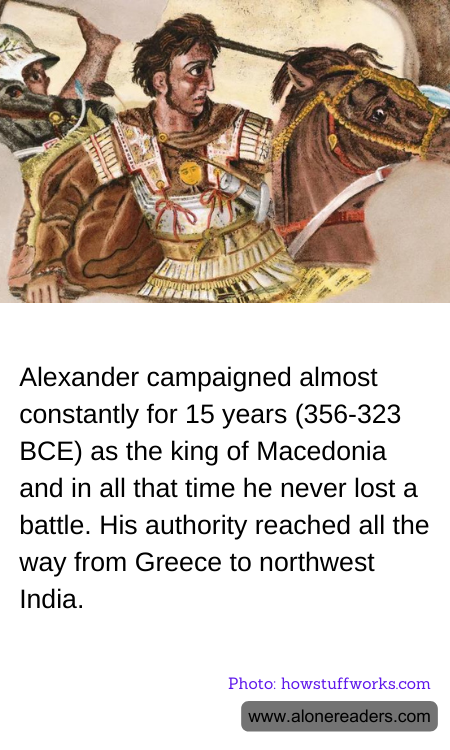
Alexander the Great, king of Macedonia, remains one of history's most revered and effective military leaders. From 336 to 323 BCE, he embarked on an aggressive campaign of conquest that would forge one of the largest empires the world has ever seen. His military prowess and strategic acumen were unparalleled, as evidenced by his unbroken string of victories across diverse and challenging terrains.
At the heart of Alexander's success was his innovative approach to warfare. He inherited a strong and disciplined army from his father, Philip II of Macedonia, who had already laid the groundwork with superior training and tactics. Alexander built on this foundation, employing a combination of phalanx and cavalry attacks that proved nearly invincible in battle. His use of the phalanx, armed with long spears and tightly arrayed in a formidable block, would disrupt enemy formations, which his highly mobile cavalry would then exploit, leading to swift and decisive victories.
His conquests began in Greece and the Balkans, where he secured his position by quelling rebellions and consolidating power. He then turned his sights on the massive Persian Empire, which he defeated at the battles of Issus and Gaugamela, despite being heavily outnumbered. Through these victories, Alexander demonstrated not only military brilliance but also exceptional leadership, inspiring his men to face overwhelming odds with confidence.
Following his conquest of Persia, Alexander continued eastward reaching India, where his army, still undefeated, finally showed reluctance to continue. The Battle of Hydaspes (326 BCE) against King Porus of the Paurava kingdom in India was one of his most challenging battles. Despite the difficulty and the resistance faced, Alexander emerged victorious yet again. This battle exemplified his ability to adapt to new warfare tactics, including fighting in the monsoon-laden terrain against war elephants, which were unfamiliar to his Macedonian troops.
Alexander's empire stretched from Greece to the western edges of India, covering numerous territories and cultures. His policy of fusion between Macedonian and Persian elements helped manage these diverse lands. However, his untimely death at the age of 32 in Babylon in 323 BCE left his empire without a clear successor, leading to its fragmentation as his generals carved out independent kingdoms.
Despite his empire's brief lifespan, Alexander's impact on the course of history was monumental. He spread Greek culture across the known world, a process that had lasting effects on the development of Western civilization and the eventual rise of the Roman Empire. His campaigns also opened up lines of communication and trade between the East and the West, fostering a level of cultural exchange that had not been seen before. His legacy of undefeated military success and visionary empire-building ensures that Alexander the Great’s name lives on as a legend in the annals of history.
