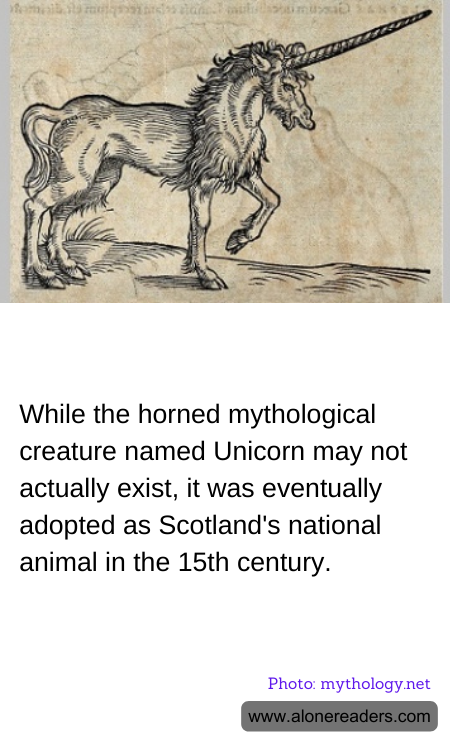
Unicorns, mythological creatures with a single, spiraling horn projecting from their forehead, have fascinated human cultures for millennia. Traditionally symbolizing purity and grace, unicorns appear in the art and myths of many ancient civilizations, from China to Greece. However, their significance uniquely evolved in Scotland where the unicorn holds a place of honor as the national animal.
The connection between Scotland and unicorns begins in the medieval period, influenced by Celtic mythology and folklore where creatures and spirits intertwined with the everyday life of the people. The unicorn was seen as a symbol of purity, innocence, and power in Celtic mythology, traits that resonated with Scottish ideals of nobility and chivalry. By the 12th century, unicorns had begun appearing on the Scottish royal coat of arms. It wasn't merely an artistic choice, but a statement of power; in medieval heraldry, the unicorn was known to be the strongest of all creatures, free and untamable.
The bond was formalized when, in the late 15th century, King James III issued gold coins embossed with the unicorn, solidifying its status as a symbol of Scottish sovereignty and might. This move was not just about embracing myth but was also a statement to other nations of the power and uniqueness of the Scottish kingdom.
The adoption of the unicorn as a national symbol was further cemented under the rule of James IV and James V, who both used the image of the unicorn in their coat of arms, often juxtaposed with England's national symbol, the lion. This heraldic symbolism represented the ongoing rivalry and balance of power between the two kingdoms before their eventual union.
Today, the unicorn remains a prominent figure in Scottish cultural iconography. It can be found supporting the Scottish coat of arms, standing opposite the English lion, a visual reminder of Scotland's history and endurance. The choice of such a mythical creature underlines the nation's love for myths and legends, intertwining the fantastical with the historical in Scotland's national identity.
The choice of a mythical animal as a national symbol also emphasizes the power of symbolism and myth in human culture—how a creature that may never have existed can nevertheless wield substantial cultural and historical influence, embody ideals, and inspire art, literature, and national sentiment. Scotland’s embrace of the mythical unicorn showcases how legends can be woven into the fabric of national identity, providing a unique emblem of purity, strength, and independence that continues to captivate and inspire.
