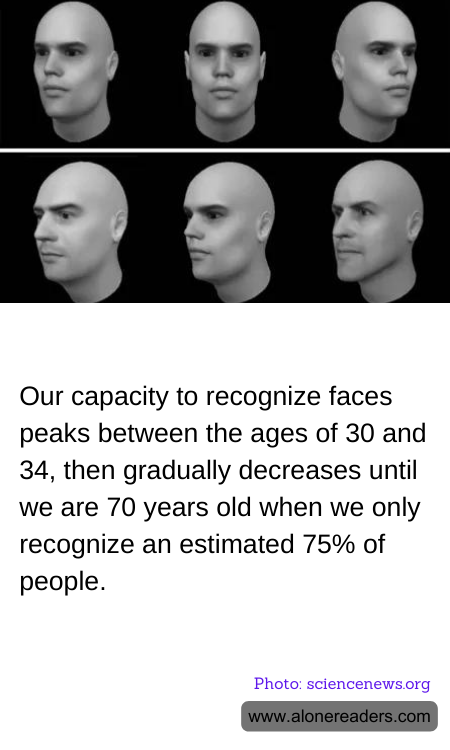
The human ability to recognize and identify faces is a crucial social skill, enabling us to interact effectively within our communities and navigate complex social dynamics. Interestingly, this skill does not remain constant throughout our lives. Research indicates that our proficiency in face recognition increases as we grow, reaching its pinnacle in our early thirties, specifically between ages 30 and 34. At this age range, individuals typically achieve their highest accuracy in recognizing and recalling faces.
This peak is believed to be linked to several factors including cognitive maturity, social exposure, and possibly increased necessity for social interaction in professional and personal life during these years. As we engage more with different people, our brains become better trained to notice and remember distinct facial features.
However, post the peak period of facial recognition ability, there starts a gradual decline. By the time individuals reach the age of 70, it is estimated that they can recognize about 75% of the faces they encounter. This decline can be attributed to several age-related factors including the general decrease in cognitive functions, reduced social engagement, and changes in visual processing abilities. Age-related eye conditions like cataracts and macular degeneration can further impair the ability to see and thus recognize fine details necessary for identifying faces.
This deterioration in face recognition can have significant social implications. Difficulties in recognizing family, friends, and acquaintances can lead to social isolation and anxiety, which in turn can exacerbate issues related to mental health such as depression. Furthermore, it may pose practical challenges in daily activities, affecting one’s independence and quality of life.
Understanding the trajectory of face recognition abilities throughout the lifespan is crucial not only for cognitive science but also for devising approaches to assist those experiencing decline. Technologies such as photo-aided reminder systems, facial recognition software, and even virtual reality could potentially help mitigate some of the challenges faced by older adults. Additionally, regular social activities and cognitive exercises tailored to enhance facial recognition skills could be beneficial in maintaining these abilities longer into old age.
Thus, while our capacity to recognize faces diminishes with age, increased awareness and proactive intervention can help manage this decline, ensuring better social integration and quality of life for the elderly.
