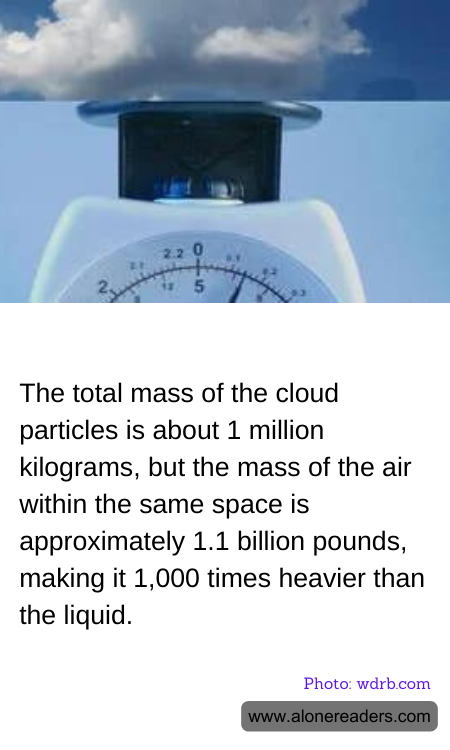
Clouds, those ethereal, floating bodies that captivate with their ever-changing shapes and sizes, are actually composed of minuscule particles suspended in the air. When we marvel at a picturesque sky filled with clouds, we are often unaware of the extraordinary contrast in mass between the cloud particles and the air surrounding them. Typically, the total mass of the cloud particles in a given space might be around 1 million kilograms. This may sound substantial, but it is dwarfed by the mass of the air within the same volume, which roughly equates to 1.1 billion pounds. This stark difference highlights that air, though seemingly light and invisible, actually carries a significant amount of mass.
The discrepancy in mass is primarily due to the density and composition of clouds compared to air. Clouds consist mostly of tiny water droplets or ice crystals, depending on the altitude and temperature, which form when water vapor in the air condenses. Even when densely packed, these particles are much lighter than the nitrogen, oxygen, and other gases in the air, which collectively add up to a much larger total mass. This fascinating aspect of clouds underscores not only the wonders of meteorological phenomena but also the intricate balance of our atmosphere.
Understanding such dynamics is crucial for meteorologists and scientists as they predict weather patterns and study the environmental impact of atmospheric changes. Knowing the mass of clouds relative to the air is essential for accurate climate models and weather forecasting. These models help in predicting precipitation, storm movements, and even broader phenomena such as climate change effects, thereby enabling better preparation and response strategies.
Therefore, while clouds might seem like light, fluffy forms floating effortlessly in the sky, they are part of a complex and weighty atmospheric system. The interaction between cloud particles and the surrounding air plays a critical role in our weather systems and the overall health of our planet, reflecting a dynamic interaction of elements that is both delicate and powerful.
