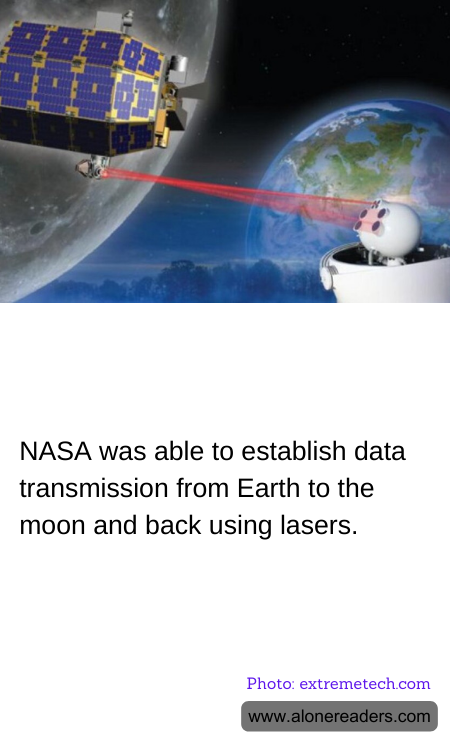
NASA's recent breakthrough in data transmission marks a significant milestone in space communication technology. They achieved this feat by transmitting data from Earth to the Moon and back via lasers, a method known as optical communication. This harbors potential to revolutionize how we send and receive data across space, ensuring rapid, high-volume information transfer that can be vital for deep space exploration missions, including future manned missions to Mars.
Traditional radio frequency communications have been the backbone of extraterrestrial data transmission, but they possess limitations in speed and bandwidth. Laser communication, by contrast, offers a much higher bandwidth, which allows for faster data rates. This technological shift could enable the streaming of high-definition video from space, provide more timely updates on mission status, and enhance the speed at which we receive scientific data.
The technical aspect involves using infrared lasers to send packets of information through space. This technique must overcome various challenges, such as the dispersion of laser beams over large distances, turbulence in the Earth's atmosphere, and precise pointing accuracy to target receiving equipment over vast distances. To achieve successful transmission, NASA utilized telescopic and photon-sensitive receivers capable of detecting the weak signals after their long journey between celestial bodies.
This success of laser communication not only sets the groundwork for more sophisticated communication networks in space but also carries implications for enhancing Earth-based communications infrastructures. Such advancements could significantly reduce the latency and increase the bandwidth of satellite internet services, thereby providing more reliable and faster internet access to remote and rural areas around the world.
As NASA continues to refine this technology, it will play an essential role in the Artemis missions, which aim to return humans to the Moon and establish a sustainable presence by the end of the decade. Improving communication technology is fundamental to the success of these missions, ensuring that astronauts have real-time support from mission control and access to the benefits of Earth's scientific and medical community. Laser communication holds the promise of making these aspirations more achievable, securing a new era of space exploration.
