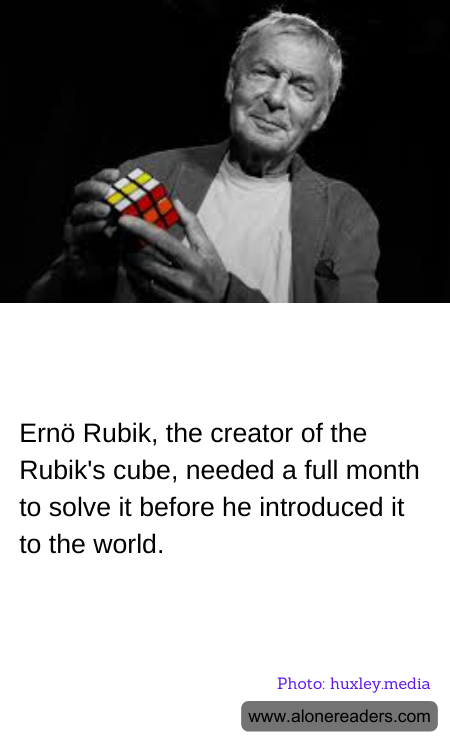
The story of the Rubik’s Cube begins with Erno Rubik, a Hungarian architect and professor of architecture, who invented the Cube in 1974. Initially designed as a tool to help explain three-dimensional geometry, the Rubik's Cube transcended its educational purpose, becoming one of the most popular puzzles in history. Interestingly, after its creation, Erno Rubik himself could not solve the cube for an entire month, showcasing the puzzle's challenging nature.
Rubik called his invention the "Magic Cube," and it was initially sold only in Hungary. It was not until 1980, after the puzzle was licensed to the Ideal Toy Corp and renamed the "Rubmarikik'ssk'ssCtheube," that it gained global fame. The Cube's appeal lies in its apparent simplicity paired with the challenge it offers. With over 43 quintillion possible configurations, solving the Cube can be daunting. The first time Rubik solved his own puzzle, it marked a significant achievement, reflecting both human ingenuity and perseverance. This breakthrough was pivotal; it allowed Rubik to refine the Cube's design for a broader audience.
The Rubik's Cube has since become more than just a toy or puzzle; it symbolizes problem-solving and creativity. Education systems around the world utilize the Rubik’s Cube to teach mathematics and problem-solving skills. The Cube has also inspired a competitive community and a substantial body of enthusiasts who continuously strive to devise new solutions and achieve faster solve times.
The lasting impact of the Rubik's Cube is a testament to its design and to Rubik's innovative vision. Decades later, the Cube continues to challenge and inspire people around the world, maintaining its place as a cultural and intellectual icon.
