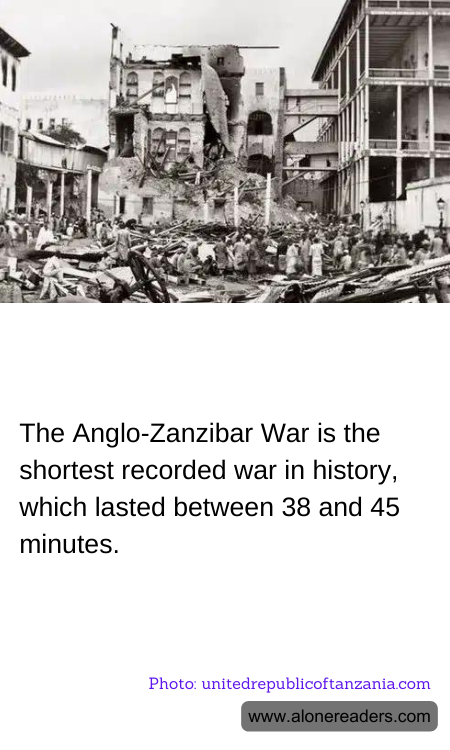
The Anglo-Zanzibar War, which erupted on August 27, 1896, holds the record as the shortest war in history, lasting just between 38 and 45 minutes. This brief but intense conflict was the result of a succession dispute after the pro-British Sultan Hamad bin Thuwaini died on August 25, 1896. Sultan Hamad had been a cooperative ally of the British Empire, which by then had substantial economic and strategic interests in Zanzibar, primarily as a major trading hub on the eastern coast of Africa. His sudden death sparked a succession crisis when his cousin, Khalid bin Barghash, unilaterally assumed power without British approval.
The British authorities were concerned that Sultan Khalid’s ascension could threaten their interests in the region. They favoured another candidate, Hamoud bin Mohammed, who they believed would be more amenable to British interests. Thus, the British issued an ultimatum to Sultan Khalid: either step down and leave the palace or face military action. Refusing to acquiesce, Sultan Khalid fortified his palace, gathering around him a small force of around 2,800 men and a modest arsenal of artillery, machine guns, and a royal yacht equipped with guns.
When the ultimatum expired on the morning of August 27, the British forces, commanded by Rear Admiral Harry Rawson, launched an attack. The British fleet, which included three cruisers and two gunboats, bombarded the Sultan’s palace. The superior firepower of the British quickly overwhelmed Sultan Khalid's forces. Within 38 to 45 minutes, the palace had been incapacitated, and Khalid had fled, seeking refuge in the German consulate before later escaping to German East Africa (modern-day Tanzania).
During this short conflict, approximately 500 defenders of the palace were killed or wounded, while only one British sailor was injured. With the flight of Sultan Khalid, the British quickly installed Sultan Hamoud, who agreed to rule under conditions favorable to British interests, including the abolition of slavery, an act that had significant economic and cultural impact in the region.
The Anglo-Zanzibar War, albeit brief, was a telling episode in the context of European imperialism in Africa. It reflected the extent to which European powers were willing to go to protect their strategic and economic interests abroad. Moreover, this miniature war underscored the dynamics of power, authority, and influence in colonial Africa, highlighting the fragility of local rule when confronted by the might of colonial empires. The conflict remains a significant, if brief, chapter in the history of British colonial endeavors in East Africa, encapsulating the tensions and transformations of the age of imperialism.
