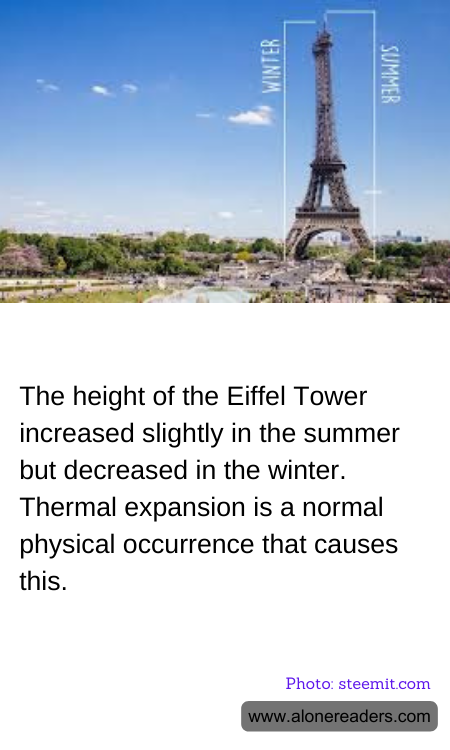
The Eiffel Tower, an iconic symbol of French ingenuity and a major tourist attraction, experiences a fascinating physical phenomenon: its height varies slightly with the seasons. During the summer months, the Eiffel Tower can grow by up to 15 centimeters (about 6 inches) due to the expansion of its iron structure. This phenomenon, known as thermal expansion, occurs because the metal heats up and expands in higher temperatures.
Iron, like many other materials, is composed of atoms that vibrate at various frequencies depending on their temperature. When the iron of the Eiffel Tower is heated during the warm summer months, the atoms gain kinetic energy and move apart from each other, causing the iron to expand. Therefore, the structure increases slightly in height as the temperature rises.
Conversely, during the winter, the cooler temperatures cause the atoms in the iron to lose energy and move closer together, resulting in the contraction of the material. Consequently, the Eiffel Tower shrinks back to its original height, decreasing by the same amount it expanded in the summer.
This height fluctuation is a perfect example of how even large and solid structures are not completely rigid and are subject to the laws of physics. The designers of the Eiffel Tower, including Gustave Eiffel, accounted for this movement in their architectural plans. Special joints and assembling techniques were employed to ensure that the integrity and stability of the tower are maintained despite its seasonal movement.
Despite this movement being very slight, it's a testament to the dynamic nature of the materials used in construction, their interaction with the environment, and the foresight of engineers and designers who plan for these changes in their constructions. The Eiffel Tower not only represents a monumental achievement in architecture and engineering but also continues to serve as a real-world example of the principles of material science in action.
