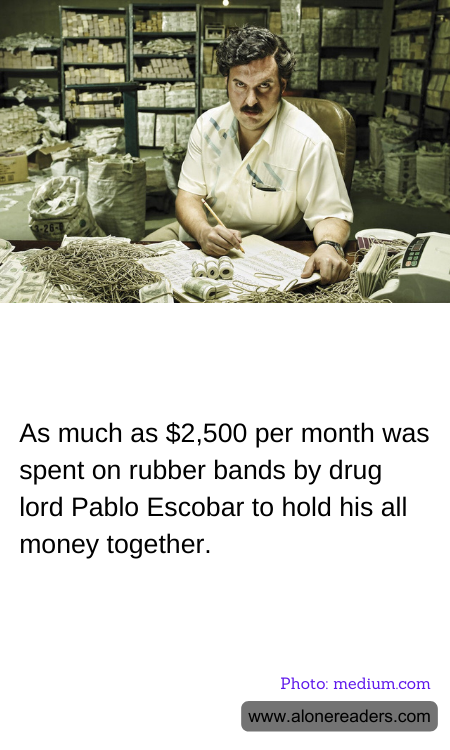
Pablo Escobar, one of the most notorious drug lords in history, was said to have amassed an unimaginable fortune through his illicit drug operations. At the height of his power, Escobar's Medellín Cartel controlled a significant portion of the cocaine transported to the United States and other countries. The vast amounts of money generated from these operations presented unique challenges, including how to physically manage and store the cash. It has been reported that Escobar spent as much as $2,500 per month on rubber bands alone, just to keep his stacks of cash bundled together. This seemingly minor detail underscores the immense scale of his wealth.
Escobar's financial situation was so extreme that money was not only stored in the usual safes or bank accounts but also stashed in houses, fields, and even in dilapidated warehouses. The rubber bands were essential for organizing the piles of cash, reportedly amounting to billions of dollars, that came in daily. This practice also reflects the logistical issues faced by major criminal enterprises: managing the proceeds in a way that avoids detection and loss, whether from law enforcement seizures or from decay and mismanagement.
The anecdote about spending thousands on rubber bands is part of a larger narrative illustrating both the absurdity and the dark reality of the drug trade during Escobar’s era. Despite the folkloric status that such stories have earned, they also highlight the deep impacts of drug trafficking, including violence, corruption, and societal disruption. Escobar’s legacy, while fascinating to some due to tales of extravagant spending and Robin Hood-like gestures, remains ultimately a cautionary tale about the corrupting power of seemingly unlimited wealth obtained through criminal means. It serves as a stark reminder of the complexities and dangers inherent in the world of high-stakes organized crime.
