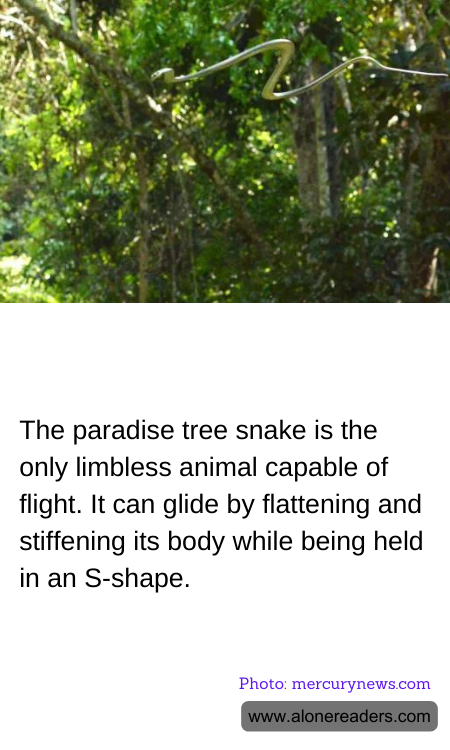
The paradise tree snake, a remarkable creature residing in the lush forests of Southeast Asia, has evolved an extraordinary method of locomotion that sets it apart from other limbless animals. Unlike any other snake, the paradise tree snake has the capability to "fly" — or more accurately, glide through the air. This ability is not true powered flight like that of birds, but rather a controlled glide that can carry it from tree to tree without having to descend to the ground. This unique adaptation serves as an effective means to travel, escape predators, and hunt.
The mechanics behind the paradise tree snake's gliding ability are fascinating. When preparing to glide, the snake propels itself from the branches of trees with a powerful thrust. Mid-air, it transforms its body into a flattened shape by splaying its ribs, creating a surface area that acts somewhat like a parachute. This shape not only helps to support the snake’s body during the glide but also provides a certain degree of lift, which is unusual for a gliding animal.
To steer and stabilize itself, the snake uses a motion where its body forms an 'S' shape. By making undulating movements, similar to the ones it uses for slithering on the ground, the snake can control the direction and speed of its glide. This ability to maneuver while gliding is crucial, as it allows the paradise tree snake to effectively navigate through the dense foliage of its habitat, avoiding obstacles and pinpointing landing spots with remarkable accuracy.
Studies have shown that during a glide, the paradise tree snake can cover a horizontal distance of up to 10 meters (about 33 feet) from a launch height of only 5 meters (about 16 feet), achieving impressive glide ratios considering its body structure. This not only highlights the efficiency of its gliding mechanism but also signifies the importance of such capabilities in the survival and ecological dynamics of these snakes.
The gliding capability of the paradise tree snake is just one example of the remarkable adaptations that animals have developed to thrive in their environments. It underscores nature’s ingenuity and suggests that there may be other, yet undiscovered methods of locomotion among other species. As studies continue, the paradise tree snake will remain a subject of keen interest for scientists eager to understand the full extent of biomechanics and evolutionary biology among reptiles.
