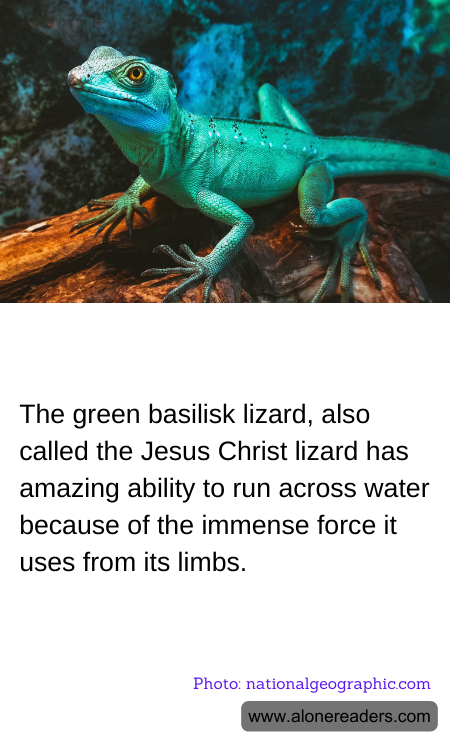
The green basilisk lizard, also known as the Jesus Christ lizard, possesses an extraordinary ability that seems almost miraculous: it can run across water. This remarkable capacity, which earns it its biblical nickname, is not due to divine intervention but rather an impressive adaptation to its environment.
Native to the tropical rainforests of Central America, from southern Mexico to Ecuador, the green basilisk thrives near water bodies such as rivers and streams. When threatened by predators, it can escape by sprinting upright on its hind legs at speeds of about 5 feet per second across the water's surface. This escape mechanism is crucial for its survival in the wild, where predators are abundant.
The science behind this lizard's ability to walk on water lies in its uniquely designed feet and powerful limbs. Each of the rear feet is equipped with long toes flanked by skin flaps. When the lizard runs, it slaps its feet hard against the water, creating a tiny air pocket that keeps it temporarily afloat. As it whips its legs through the water, the fringes spread out, increasing the surface area and, consequently, the lift. These biomechanics create enough force to counteract gravity and prevent the lizard from sinking, provided it maintains its speed.
Despite their lightweight bodies - typically weighing between 150 to 200 grams - the pressure and speed must be perfectly balanced for the basilisk to achieve this feat. Scientists believe that both the lizard’s stride length and its body’s interaction with the water's surface tension are finely tuned to optimize this ability.
Research into the green basilisk lizard's ability to run on water has inspired biomimetic applications in robotics and materials science. Engineers are looking into ways to replicate this natural mechanism to develop robots that can traverse swampy or watery terrains more effectively, which could be invaluable for environmental monitoring and search-and-resume missions in aquatic environments.
Conservation efforts are crucial for maintaining the population of these fascinating lizards, as habitat loss due to deforestation poses a serious threat to their survival. Protecting the lush environments that support the green basilisk also supports the broader ecosystem that relies on these biodiverse habitats. Thus, understanding and appreciating unique species like the green basilisk lizard can further enhance our commitment to preserving the rich tapestry of life that our planet harbors.
