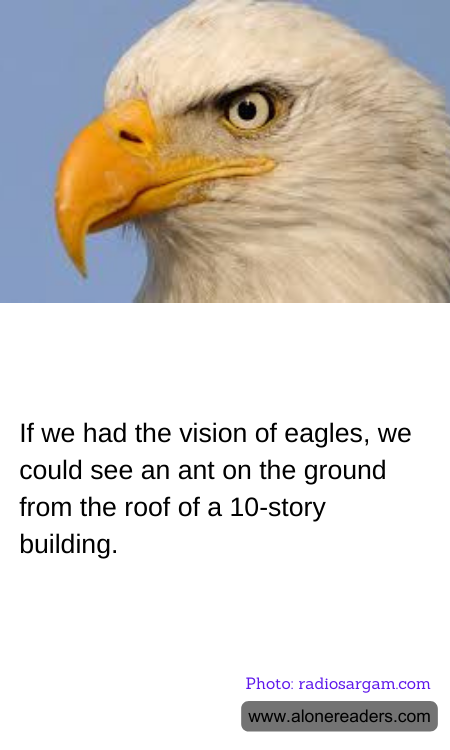
Eagles are renowned for their exceptional eyesight, a capability far superior to that of humans. If we possessed the vision of these majestic birds, the world would appear very different. Eagles can spot small prey from several kilometers away, an ability that is critical for their hunting success. They have large pupils which ensure minimal diffraction (bending) of the incoming light, allowing a sharp focus. Imagine looking at a detailed landscape from a high vantage point, with every leaf, small creature, and color variation visible in extraordinary detail.
Furthermore, eagles have a higher number of sensory cells in their retinas, especially a type called cones, which are responsible for color vision. These cells are densely packed, providing acute visual resolution. Their eyes are also aided by a deep fovea, a pit that provides an intense focus, making their ability to gauge depth and speed exceptional.
If humans had such vision, life would change dramatically. From a rooftop of a 10-story building, spotting an ant crawling on the sidewalk would be as easy as noticing a dog walking across the street. Such ability would not only redefine normal human activities like driving and sports but also enhance fields like surveillance and search and rescue operations. It would minimize risks in many professional fields like firefighting or police work, by allowing for a clearer assessment of danger from a distance.
Moreover, enhanced vision would transform the arts and entertainment, likely giving rise to new forms of visual arts and media. Photographers and filmmakers might find new perspectives for their work, pushing the limits of what can be captured on camera. In everyday life, the increased ability to observe fine details could lead to a greater appreciation of our environment, promoting more conscientious interactions with nature.
However, such powerful vision comes with its trade-offs. Eagles, for instance, rely heavily on their eyesight for survival, which demands a considerable amount of brain power and may overshadow other senses. For humans, it could mean relearning how to process visual information efficiently. Despite these drawbacks, the ability to see like an eagle could open up a new range of experiences and understandings of our world, transforming the ordinary into the extraordinary with just a look.
