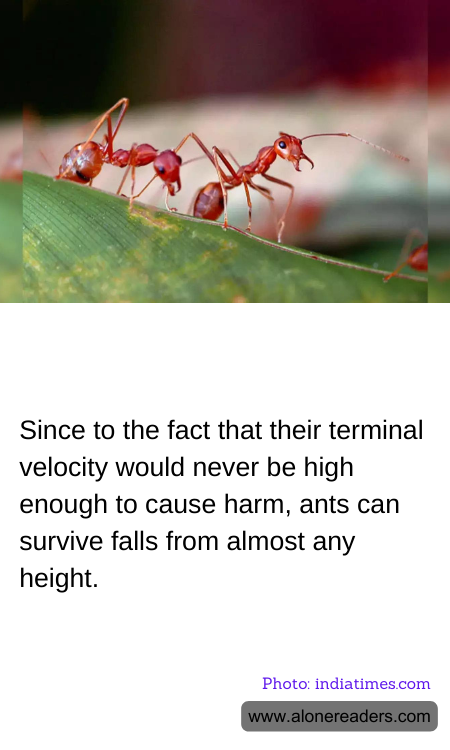
Ants are among the most intriguing creatures when it comes to their ability to survive falls from extraordinary heights. Unlike humans and many other animals, ants can fall from a great height and walk away unscathed. This remarkable survival skill is primarily due to their small size, lightweight, and unique body structure.
One key factor in their high survival rate from falls is their low terminal velocity. Terminal velocity is the highest speed an object reaches as it falls through air. For ants, this speed is remarkably low because they have a low mass and a larger surface area relative to their weight. This combination significantly slows their fall, allowing them to gently land on the ground. Additionally, the exoskeleton of an ant is incredibly tough relative to its size, which helps protect it from impacts.
Interestingly, the way an ant’s body is structured also contributes to their ability to survive falls. Their bodies are highly segmented and flexible, allowing for distribution of the impact force more evenly across their structure. This flexibility combined with their lightweight form means that they don’t hit the ground with much force, thus reducing the risk of injury.
Moreover, ants are equipped with claws and sticky pads on their feet that allow them to grab onto surfaces as they fall, decreasing the impact when they reach the ground. This ability not only helps in cushioning the fall but also in climbing and navigating their environment efficiently.
From an evolutionary perspective, this ability to withstand falls is incredibly beneficial. Since ants often climb trees and other tall structures in search of food or nesting sites, being able to survive falls from such heights gives them a significant survival advantage. It allows ants to explore and colonize areas far from the ground without the risk of fatal falls limiting their mobility.
In conclusion, ants exhibit an amazing feat of natural engineering that allows them to survive falls from any height. Their small size, low terminal speed, robust body structure, and climbing abilities contribute to their toughness, illustrating a fascinating aspect of their survival. This characteristic is just another testament to the complexity and adaptability of these small yet mighty creatures.
