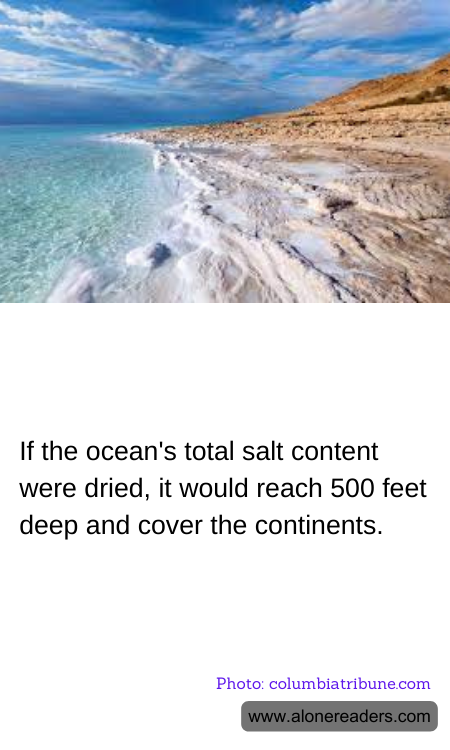
The vastness and mystery of the world's oceans are frequently underscoreed by their depth and the life they harbor. However, an equally fascinating aspect is their salt content. The oceans are not just expanses of water; they are also immense salt reservoirs. If we were to extract and dry all the salt contained in the ocean, it would create a layer approximately 500 feet deep, covering the continents.
This staggering fact can be attributed to the enormous volume of the world’s oceans, which cover about 71% of the Earth’s surface. The average salinity of seawater is about 35 grams of salt per liter of water. When you multiply this by the estimated 1.332 billion cubic kilometers of water in the oceans, the total salt content becomes almost unimaginably vast.
This hypothetical scenario, where all this salt covers the continents, helps underscore the massive mineral "store" our oceans represent. Such a layer, hundreds of feet thick, would radically alter every aspect of the terrestrial environment. Landscapes would morph drastically, ecosystems would be devastated, and the climatic shifts could be catastrophic.
It’s interesting to consider the origins of this saltiness. The majority comes from runoff from the land; minerals washed away from rocks and soil, flowing into the sea. Over the millennia, this process has contributed to the saline nature of the oceans. In fact, if the Earth were completely flat and the salt was evenly distributed across its surface, scientists estimate that it would create a layer about 500 feet thick.
The thought experiment serves not just as a curious factoid about our planet's makeup but also as a reminder of the intricate connections between the land, sea, and atmospheric systems. It is a reflection of Earth's geological and hydrological processes at work, highlighting the balance of natural elements that is so crucial yet often taken for given. Understanding these relationships is key to appreciating and protecting our planet’s dynamic system, which is vital as human activities continue to unduly influence Earth’s natural state.
