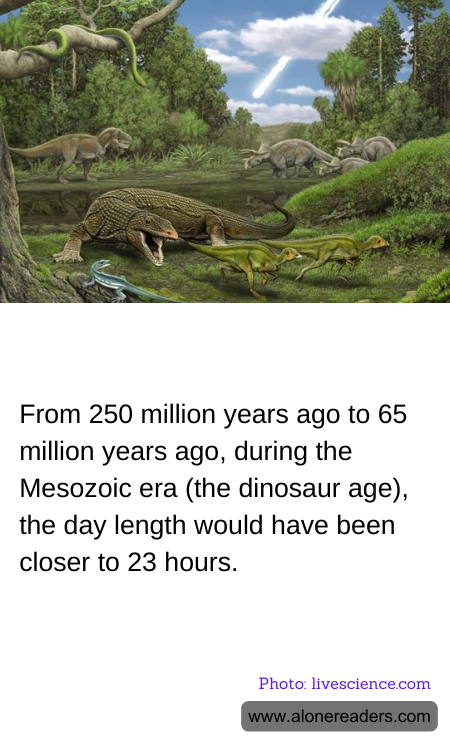
The Mesozoic era, often referred to as the "Age of Reptiles" or the "Age of Dinosaurs," spanned approximately 180 million years, from 250 million to about 65 million years ago. This period is critical in Earth's history, marking significant evolutionary, climatic, and geological transformations. Among these changes, a less frequently discussed but scientifically intriguing aspect is the variation in the length of a day during this era.
Current research indicates that during the Mesozoic era, the day length was roughly 23 hours, shorter than our current 24-hour day. This phenomenon can be attributed to the rotational speed of the Earth, which has been gradually slowing down over geological time scales due to the tidal forces between the Earth and the Moon. These tidal forces exert a drag on the Earth's rotation, acting to gradually decelerate it.
This change in rotational speed has various implications not only for the dynamics of Earth's geophysical processes but also for the lives of the organisms that inhabited the planet, including the dinosaurs. A shorter day could have influenced the behavior patterns of these creatures, including their feeding and migratory habits, as they would have experienced more daylight hours within a given year.
Moreover, the faster rotation might have had broader environmental impacts, such as more pronounced seasonal variations and potentially more rapid weather changes. These conditions could have shaped the evolutionary pathways of many species during the Mesozoic by affecting ecosystems and the food chain dynamics at the time.
Understanding these historical details is not merely an exercise in curiosity but serves practical purposes as well. It helps scientists better model and predict contemporary Earth's climate and ecological responses as well as gives insight into the biological rhythms that may have governed ancient life on Earth. Hence, studying changes like those in day length during the dinosaur age offers keys to unlocking both past and future secrets of our planet.
