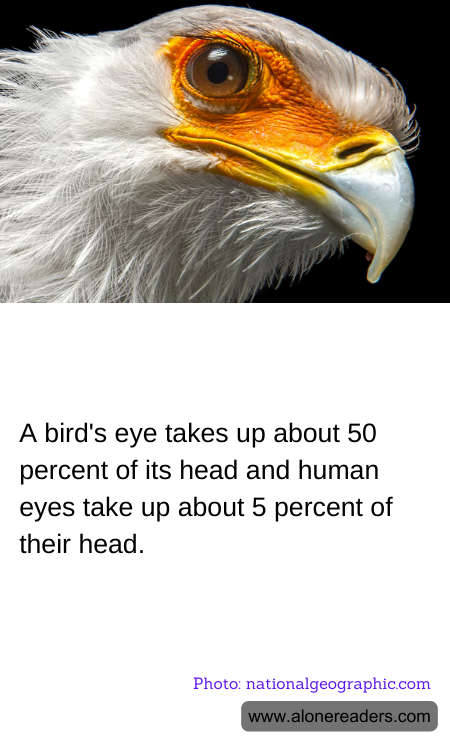
Birds and humans, despite both having complex visual systems, exhibit striking differences in the proportion of their heads devoted to their eyes. A bird’s eye, for instance, can occupy almost 50 percent of its head. This is not merely a matter of eye size but is integral to their survival and functionality. Birds, especially predatory species like eagles and hawks, need large eyes relative to their head size to enhance their visual acuity. Larger eyes can collect more light and possess a greater density of receptors, improving their ability to spot prey from great distances.
In contrast, human eyes take up about 5 percent of the head, which reflects differences in evolutionary pressures and habitat needs. Humans, being generalist survivors rather than specialized hunters, utilize a broader sensory balance, relying on a combination of visual, auditory, and other sensory cues to interact with the environment. The human eye, while smaller in proportion, is highly adapted for acute color vision and depth perception, facilitating complex tasks like reading, driving, and detailed manual work.
The disparity in eye size relative to head size between birds and humans highlights an interesting aspect of evolutionary biology. It shows how different species have adapted their sensory systems in diverse ways to meet specific environmental challenges. These adaptations underline the intricate relationships among form, function, and survival in the animal kingdom. Such comparisons not only deepen our understanding of anatomy and physiology across species but also illustrate the profound impact of ecological niches on the evolutionary pathways of organisms. Thus, while birds dazzle with their enormous, sharp eyes, humans navigate the world with a balance of senses tuned for a variety of tasks beyond those of mere survival.
