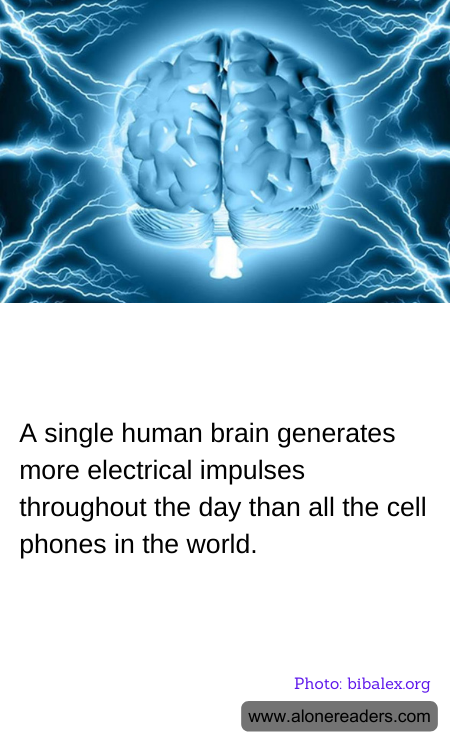
The wonder of the human brain is something that continues to astonish scientists and researchers worldwide. Within our skulls lies the most complex organ in our body, an organ capable of producing more electrical impulses in a day than all the smartphones on the planet. This comparison not only highlights the remarkable capabilities of the human brain but also puts into perspective the sheer volume of activity and processing power it holds.
Every thought, memory, sensation, and emotion is governed by these electrical impulses. Generated by billions of neurons communicating through synapses, these tiny signals form the basis of all our cognitive processes. When we consider the brain’s capabilities in relation to technology, such as cell phones, it's important to note that while these devices are powerful tools for communication and information processing, they pale in comparison to the biological processing power of the human brain.
The brain's ability to generate such a vast amount of electrical activity is crucial for multitasking and complex thought processes that define human intelligence and consciousness. Unlike cell phones, which require signals to travel across various networks to communicate data, the brain's signals are instantaneous and encompass dimensions that are not purely linear or confined to binary sequences.
Moreover, this immense electrical activity assists not just in routine tasks but also in the brain's ability to innovate and empathize, capabilities that are currently beyond the reach of the world’s most advanced computers or smartphones. Each neuron in the brain can form thousands of links with other neurons, giving it a level of connectivity and speed that engineers are still trying to replicate in artificial intelligence systems.
Understanding that the brain outstrips the combined capabilities of all cell phones globally offers a humbling view into its complexity and efficiency. It provides a perspective that enhances our appreciation for the human brain's potential and challenges us to continue exploring its mysteries. As technology advances, this awareness also pushes scientists and engineers to develop more sophisticated machines and systems that can come closer to mimicking the human brain's dynamic structure and functionality, possibly heralding a new era of technology inspired by the most natural supercomputer humans possess.
