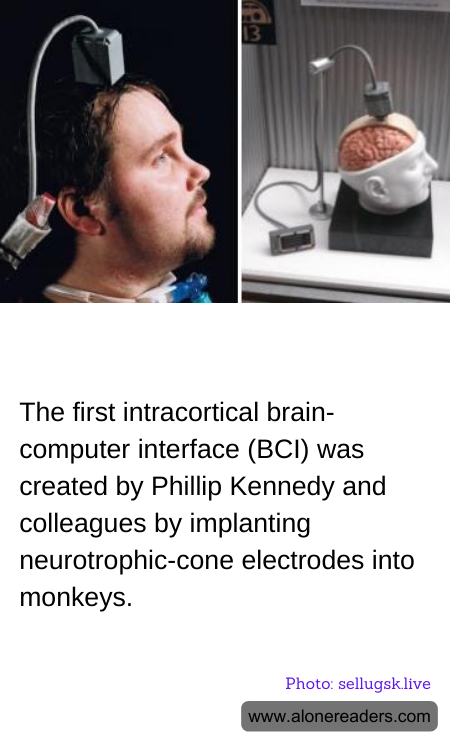
The development of the first intracortical brain-computer interface (BCI) marked a significant milestone in neuroscience and bioengineering. This pioneering technology, developed by Phillip Kennedy and his colleagues, involved implanting neurotrophic-cone electrodes into the brains of monkeys. This groundbreaking procedure laid the foundational framework for subsequent advancements in direct neural interfacing, which may one day allow humans to control external devices with their thoughts alone.
The neurotrophic-cone electrodes used in these early experiments were designed to encourage nerve growth inside the cone. This growth would, in turn, create a robust biological interface, enhancing signal acquisition and stability. The monkeys were then trained to control a computer cursor through the interface by thinking about moving their limbs, while their actual movements were restricted.
This early BCI technology demonstrated that it was possible to capture and translate neural activity into actionable commands in a computer system, thereby enabling an individual to interact with and control external technology directly through brain signals. This has profound implications for a variety of fields, from medicine to computer gaming, and even for advanced prosthetics.
In the medical realm, for instance, such interfaces could revolutionize the way patients with severe motor disabilities interact with the world. Imagine a future where paralyzed individuals can control robotic limbs, or even regain control of their original limbs, through thought alone. Beyond medical applications, BCIs might also transform the interface between humans and computers, leading to more intuitive and seamless interactions with technology.
Despite these exciting prospects, the development of BCIs also presents significant ethical, technical, and physiological challenges. These range from the risks associated with brain surgery to the long-term viability of implants and the potential for privacy violations. Nonetheless, the continual research and development driven by initial experiments like those conducted by Kennedy and his team provide hope for overcoming these hurdles.
The evolution from those early experiments with monkeys to today's sophisticated human trials underscores a trajectory of rapid innovation and enduring exploration in the field of brain-computer interfaces. Each new generation of BCIs brings us closer to a future where the integration of human cognition and machine functionality is seamless and universally beneficial.
