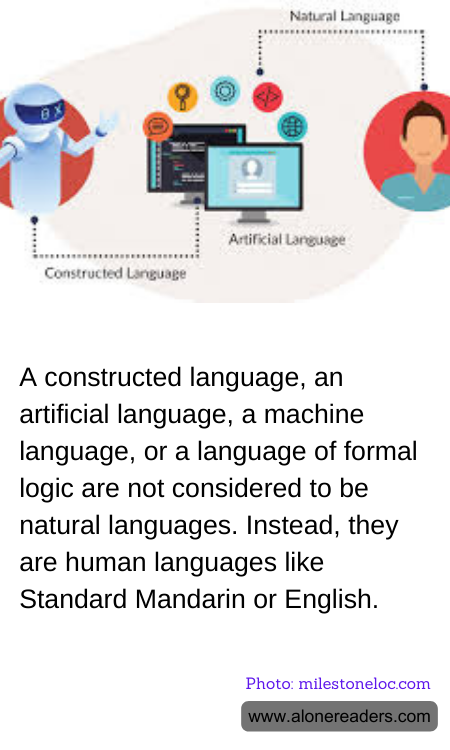
Natural languages, such as Standard Mandarin or English, evolve organically over time and are deeply rooted in human cultures and societies. They develop naturally among people and are passed from generation to generation, constantly changing and adapting. These languages are characterized by their complex, irregular grammatical structures, and their vocabulary evolves continually as societies innovate and cultures shift.
In contrast, constructed languages (conlangs) like Esperanto, artificial languages designed for specific functional purposes, machine languages which are used in computing to communicate instructions to computers, and formal logical languages utilized in mathematical and philosophical logic, do not evolve through natural, cultural processes. Instead, these languages are intentionally crafted by individuals or groups of people with specific goals in mind. Conlangs are often created to facilitate easier and clearer international communication, while artificial languages might be developed for fictional or theoretical purposes. Machine languages, albeit simpler in structure, are designed to operate within the constraints of computer systems, translating complex programming instructions into a format that machines can process. Meanwhile, languages of formal logic are used to express logical relations and propositions with precision and unambiguity, often supporting scientific research or philosophical inquiry.
The primary distinction between natural and artificial languages lies in their origins and purposes. Natural languages are a byproduct of human nature and social interaction, inherently flexible and adaptable. They carry cultural meanings and contexts that evolve spontaneously. Conversely, artificial languages are tools created by humans to serve specific, often utilitarian functions. They do not evolve through usage or belong to a particular culture, but are instead static, with controlled vocabularies and strict rules.
The implications of this distinction are significant in fields ranging from linguistics to computer science and artificial intelligence. Understanding the natural language involves not just grasping vocabulary and grammar but also cultural nuances and contextual subtleties that can be challenging to replicate in artificial systems. That's why despite advancements in technology, artificial and machine languages still struggle to fully capture the depth and fluidity of natural human languages. They are constructed, not grown; engineered, not evolved, serving as tools rather than living, breathing elements of human identity.
