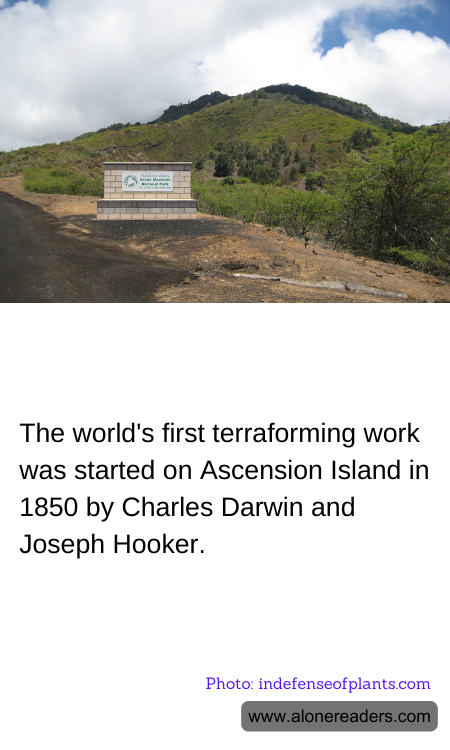
In the mid-19th century, Ascension Island, a volcanic island in the Atlantic Ocean, became the site of an ambitious ecological experiment that can arguably be considered the world’s first terraforming project. Before this undertaking, Ascension Island was a barren and desolate locale with a harsh, dry landscape that offered little in terms of natural resources. The transformation of Ascension Island began under the guidance of two notable British scientists, Charles Darwin and Joseph Hooker, after Darwin visited the island in 1836 during his voyage on the HMS Beagle.
Darwin was struck by the island's strategic significance, particularly for the British navy, but also dismayed by its lack of fresh water and vegetation. Years later, he discussed this issue with Joseph Hooker, a botanist and close friend, following Hooker's botanical expedition to the Antarctic. The two conceived a plan to introduce plant species from other parts of the British Empire, aiming to change the island's microclimate and potentially make it self-sustaining.
The practical application of this plan was largely overseen by Hooker, who instructed the British navy on the types of trees and plants to transport to the island. The species selected were primarily chosen for their ability to survive in Ascension’s arid conditions, and included varieties from Kew Gardens in London, which Hooker was affiliated with. The goal was to increase cloud formation and rainfall through the introduction of these plants, thus improving soil quality and expanding the island’s capacity to support life.
By the late 19th century, the efforts had transformed a significant portion of Ascension Island. Green Mountain, once bare and dry, became covered with lush greenery, including bamboo, eucalyptus, and banana trees. This man-made cloud forest effectively altered the local climate, increasing humidity and, as hoped, the frequency of rainfall.
This remarkable project did not merely aim at making the island more habitable for human residents, but also forged a new ecosystem that could sustain more varied forms of life. However, it wasn’t without its ecological consequences. The introduction of non-native species led to complex interactions with the native flora and fauna, sometimes negatively impacting native species.
The transformation of Ascension Island stands as a historical precursor to modern ecological engineering and terraforming concepts, showcasing early human attempts to consciously alter ecosystems on a large scale. This venture into modifying an ecosystem was pioneering at the time and remains a significant, if contentious, part of environmental history. It underscores the power of human ingenuity and also serves as a cautionary tale on the unforeseen impacts of altering natural landscapes.
