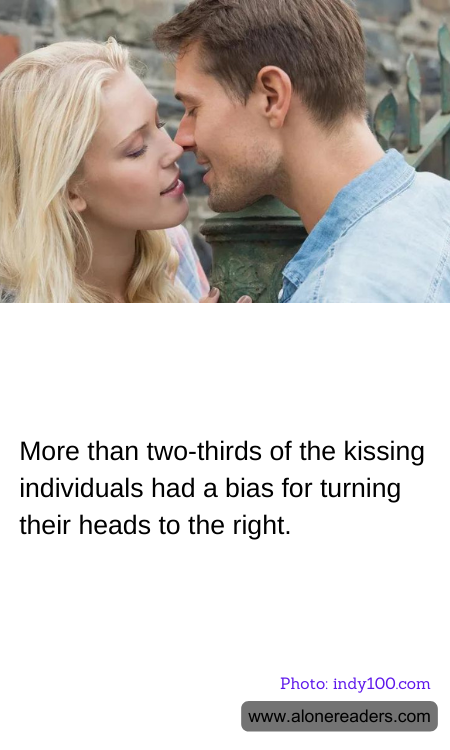
In the realm of human behavior, the subtleties of our actions often reveal more about our neurological wiring than one might might initially think. This is exemplified in the phenomena observed in kissing, where more than two-thirds of individuals have a propensity to turn their heads to the right. This intriguing detail is not just a trivial footnote in the study of affectionate behaviors but is deeply rooted in our biology.
Several studies, including those conducted by psychologists and neuroscientists, suggest that this head-turning preference is linked to the brain's hemisphere dominance. The majority of people are right-handed, a trait controlled by the left hemisphere of the brain, which also governs speech and language. This hemispheric dominance is thought to influence physical movements and could extend to the direction one tilts their head during a kiss.
Exploring further, researchers posit that this behavior is instilled early in life. It is consistent with how, during infancy, head-turning preferences are observed—such as the way a baby tilts their head to the right while being held or fed. This early bias could evolve into other physical interactions, such as hugging or kissing. Interestingly, the direction of head tilt in kissing is also culturally influenced. Studies have shown variations in head-tilting bias in communities where left-handedness is more socially accepted or where other cultural factors come into play.
Moreover, this phenomenon is not only restricted to humans. Similar behaviors have been observed in other animals, indicating that head-turning during affectionate behavior may have deeper evolutionary roots. For instance, animals also display preferences in the direction they lean or turn, which is often related to dominant vs. non-dominant sides.
In conclusion, the preference for turning the head to the right when kissing offers fascinating insights into how deeply interconnected our emotional expressions and neurological structures are. This simple act of affection, often considered as merely romantic, is a window into the sophisticated orchestration of brain functions and developmental biology, illuminating how our simplest actions are echoes of a complex biological symphony.
