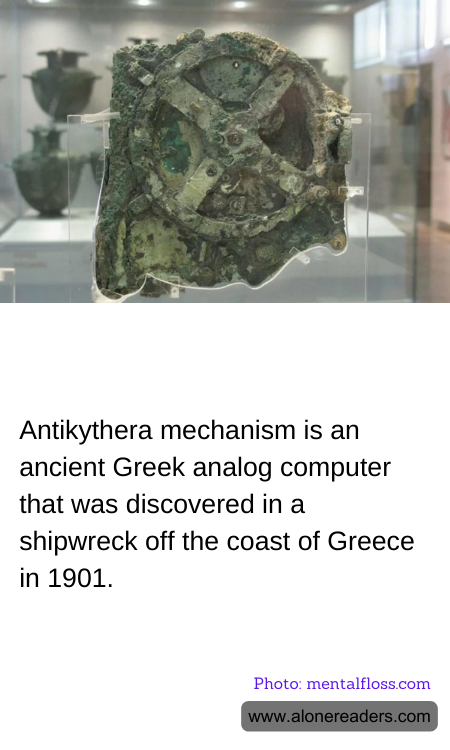
In the depths of the Mediterranean Sea near the Greek island of Antikythera, an incredible find was unearthed in 1901 during a sponge diving expedition. Amongst the remnants of a sunken ship, which has been speculated to date back to the 1st or 2nd century BC, divers found an intriguing artifact that would later be known as the Antikythera mechanism. This ancient device, often celebrated as the world's first analog computer, has since fascinated scientists, historians, and technologists alike.
The Antikythera mechanism is a complex assembly of at least 30 bronze gears housed in a wooden frame that originally would have been encased in a box about the size of a large book. Its functions are as remarkable today as they must have been revolutionary at the time. The device was used to predict astronomical positions and eclipses for calendrical and astrological purposes, as well as to track the four-year cycle of athletic games similar to the Olympics. What is particularly astonishing about the mechanism is its sophistication; its design and workmanship reflect a previously unknown, but impressively precise understanding of astronomical cycles.
Research indicates that the gears of the mechanism were ingeniously configured to follow the irregular movements of the Moon around the Earth, which vary as the Moon is subject to gravitational forces from the Sun. The device modeled these motions through a differential gear, a feat not known to have been replicated until centuries later during the medieval period.
Through various interdisciplinary studies, including advanced imaging techniques and 3D modeling, scholars have continued to decode the purpose and function of the mechanism. Findings suggest that the device could also map the positions of the planets known to the ancient Greeks: Mercury, Venus, Mars, Jupiter, and Saturn. The level of miniaturization and complexity of the Antikythera mechanism's components is comparable to that of 18th-century clocks, making it a precursor to the more modern sciences of computational machines and astronomy.
Despite the knowledge that it used dials to show both the solar and lunar calendars, pinning down the exact scope and use remains a challenge as parts of the mechanism are still missing, and ancient texts don't provide explicit references to such devices. Some experts believe it may even have been influenced by technological teachings from Babylon that were transmitted to Greece, possibly suggesting even earlier origins for these techniques.
The discovery of the Antikythera mechanism continues to offer a tantalizing glimpse into the technological brilliance of the ancients, and serves as a powerful reminder of the sophistication of ancient Greek science. It stands as a masterpiece of mechanical ingenuity that significantly predates similar advancements by centuries, highlighting an era where astronomy and engineering were intertwined with the very fabric of the spiritual and everyday life.
