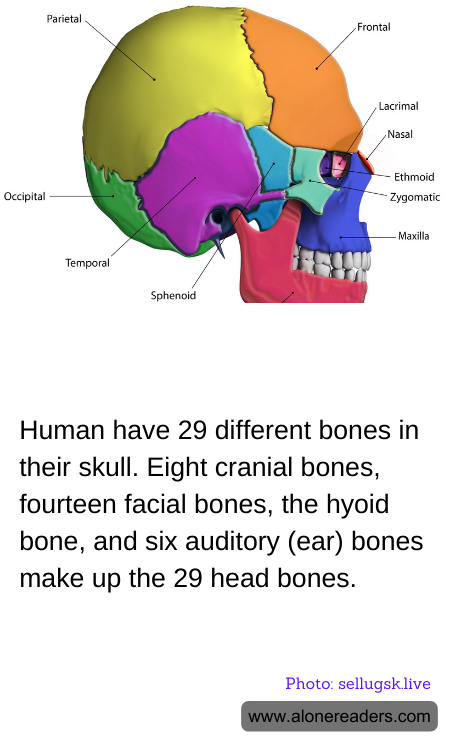
The human skull is a complex structure that serves not only to protect the brain but also to support the features of the face. Comprising 29 different bones, the skull is divided into several groups based on their functions and locations: the cranial bones, the facial bones, the hyoid bone, and the auditory or ear bones.
There are eight cranial bones in the human skull. These include one frontal bone, two parietal bones, two temporal bones, one occipital bone, one sphenoid bone, and one ethmoid bone. These bones are primarily responsible for protecting the brain and forming the structure of the area surrounding the eyes and the upper part of the nasal cavity.
The facial skeleton features fourteen bones which do not directly touch the brain but are crucial for the formation of the structure and contours of the face. These include the mandible, two maxillae, two palatine bones, two zygomatic bones, two nasal bones, two lacrimal bones, two inferior nasal conchae, and the vomer. These bones help form the upper and lower jaws, the nose, and the orbits of the eyes, and they also provide attachments for the facial muscles used in expressions.
Located in the throat, the hyoid bone is unique as it is the only bone in the human body that does not form a joint with any other bone. It serves as a support structure for the tongue, playing a critical role in swallowing and speaking.
Finally, the six auditory bones are the smallest bones in the human body. These are located within each ear and are divided into three known as malleus, incus, and stapes. The primary role of these bones is to transmit sound vibrations from the air to the fluid-filled cochlea, which is essential for hearing.
Overall, the skull's 29 bones are intricately organized to protect the brain, give shape to the head, support sensory organs, and facilitate basic functions such as eating, seeing, hearing, and facial expression. These bones are not only fundamental to physical structure and function but are also keys to understanding human evolution and forensic science. By studying the skull and its components, scientists and doctors can gain insights into our ancestral lineage, health issues related to the cranial nerves, and the effects of diseases and injuries affecting the skull.
