More About This Card
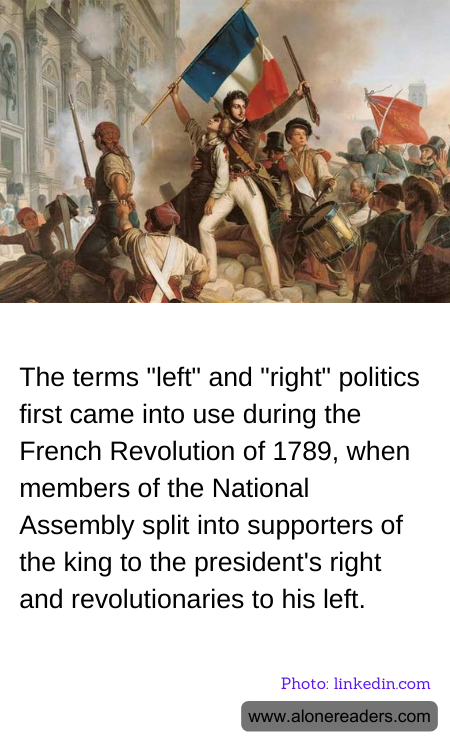
The political labels "left" and "right" originated in a highly charged historical moment during the French Revolution of 1789. In the chaotic milieu of revolutionary France, members of the National Assembly divided over their support for the monarchy. This division was physically manifested in their seating positions: those who supported the king sat to the right of the presiding officer, while revolutionaries who opposed monarchial rule sat on the left. These spatial distinctions crystallized into the political terms "left" and "right" that are still used today to denote different ideological spectrums in politics.
The terms have evolved over the centuries and now transcend the specific issues of monarchical support. In general, the right wing has come to be associated with conservative, traditionalist viewpoints, which often include a preference for a hierarchical order, a market-driven economy, and a more individualistic approach to policy and governance. Conversely, the political left is typically linked with progressive policies that prioritize social equality, environmental concerns, state intervention in the economy to redistribute resources, and a generally more collectivist approach to societal issues.
These distinctions, however, are not just historical or theoretical but are actively embodied in political parties and movements across the globe. In the United States, for example, the Republican Party is generally associated with right-wing ideologies while the Democratic Party often leans towards left-wing ideals. In Europe, many countries have clear representations of these ideologies with parties explicitly identifying as part of the left, like the Labour Party in the UK, or part of the right, like the Conservative Party.
Furthermore, the political landscape is dynamic, and the meanings of "left" and "right" continue to adapt to changing political, social, and economic climates. New issues such as digital privacy, climate change, and global migration continue to redefine political allegiances and challenge traditional conceptions of left and right. This makes the political spectrum not just a tool for classification but also a mirror reflecting the evolving issues and priorities of societies.
Understanding this historical backdrop is essential for anyone engaging with current political discourse. Recognizing the origins and evolution of these terms can lead to a more nuanced comprehension of modern political debates and the underlying principles that shape them. The legacy of the French Revolution thus continues to influence not just the semantics of politics but also the foundational principles governing political interaction and decision-making in the modern world.