More About This Card
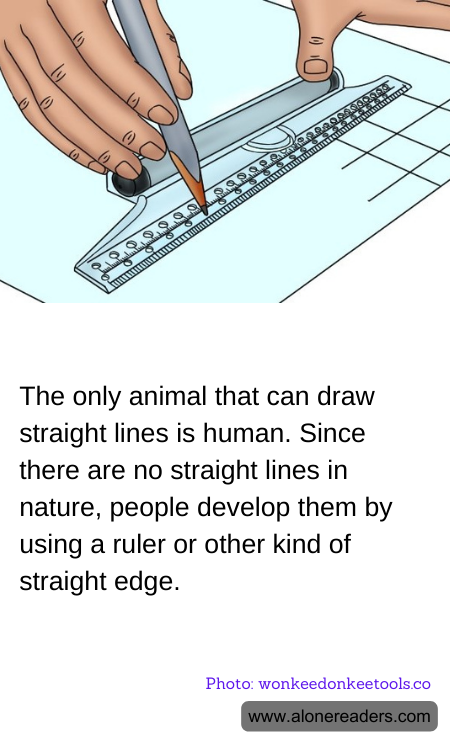
The assertion that humans are the only animals capable of drawing straight lines highlights a unique intersection between natural instinct and learned technical skills. In the wild, the concept of a straight line is virtually nonexistent, as nature tends toward irregular, curved, or jagged patterns and shapes. However, human intelligence and ingenuity have birthed the concept of the straight line, which is often symbolized as the shortest distance between two points.
Throughout history, the development and use of straight lines have had profound implications on human progress, particularly in the fields of architecture, engineering, and art. The invention of tools like rulers and straightedges allowed ancient civilizations to build more sophisticated structures, from the pyramids of Egypt to the orderly cities of the Indus Valley.
Interestingly, while humans can intentionally create straight lines, some animals inadvertently produce straight-ish lines through their movements or behaviors. For example, ants when following a pheromone trail can create paths that appear straight to the human eye. Similarly, some birds might fly in a direct, seemingly straight path when migrating. However, these are not deliberate creations of straight lines as seen in human architectural or artistic endeavors.
Drawing straight lines requires not only the ability to conceptualize linearity but also the capability to manipulate tools with precision. This involves a great deal of cognitive and manual dexterity, skills in which humans excel due to our highly developed brains and opposable thumbs. These capabilities allow for the fine motor control needed to hold a straightedge steady and draw a line without deviation.
Therefore, while nature does not create straight lines, humans have developed the ability to conceptually understand and physically manifest them. This development reflects a broader theme in human history: the drive to impose order and understanding on a naturally chaotic world, which is at the heart of scientific and artistic pursuits alike. The straight line, in its simplicity and clarity, epitomizes this human quest for structure and understanding in the universe around us.