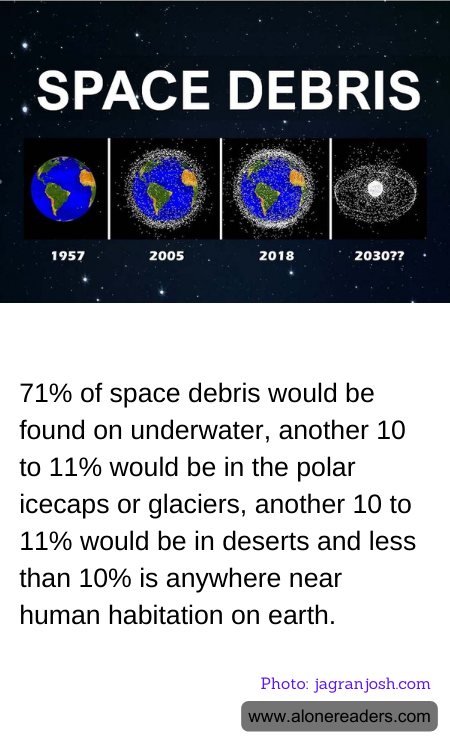
With the expansion of global space exploration and satellite launches, the issue of space debris has become increasingly prominent. While images of cluttered orbits might spring to mind when discussing space debris, the fate of these materials after they re-enter Earth's atmosphere is equally concerning. Surprisingly, a significant majority of space debris — about 71% — ends up submerged in oceans and seas. These vast watery graves conceal numerous defunct satellites and spent rocket stages, far from human sight.
Another 20 to 22% of space debris finds its final resting place in some of Earth’s most remote and uninhabited areas: polar icecaps and deserts. These regions, known for their extreme conditions and minimal human activity, inadvertently become repositories for space debris. In the polar icecaps, the cold temperatures help preserve the debris, potentially for millennia, posing a latent environmental threat. Similarly, deserts, with their vast, barren landscapes, accumulate layers of non-biodegradable remains from our extraterrestrial ventures.
Less than 10% of the debris lands in areas close to human habitats. This relatively small percentage, however, does not diminish the potential danger it poses to lives, property, and the environment. Each piece, whether large or small, can be hazardous if it lands in populated areas. The risk of damage from these remnants necessitates ongoing monitoring and management to ensure public safety and environmental protection.
The distribution of space debris has significant implications for global environmental health and safety regulations. The majority being underwater or in remote locations may seem less threatening to everyday life, but the long-term ecological impacts are profound. These debris can introduce contaminants into marine and terrestrial ecosystems and could potentially disrupt local wildlife and their habitats. Moreover, the challenge of removing debris from such inaccessible areas complicates cleanup efforts, leaving much of it to linger indefinitely.
This dispersion of space debris highlights the need for robust international cooperation in managing both space explorations and its earthly repercussions. Addressing the challenge requires a concerted effort to improve monitoring systems, enhance debris mitigation strategies during launches, and perhaps most impractically but necessarily, develop technologies to safely retrieve debris from Earth's most remote and inaccessible areas.
