More About This Card
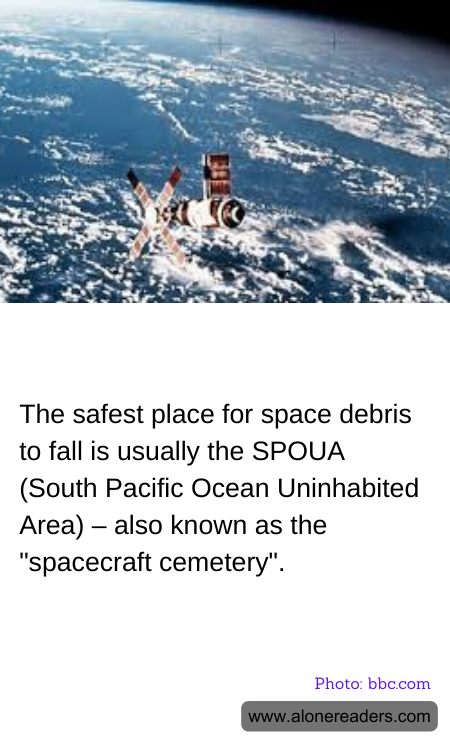
The vast expanses of our oceans serve an unexpected purpose beyond their ecological roles: they are also designated as the safest places for deorbiting spacecraft and falling space debris. Notably, the South Pacific Ocean Uninhabited Area (SPOUA), colloquially known as the "spacecraft cemetery," is one of the most preferred regions for these controlled, final descents. Situated far from human habitation, away from bustling shipping routes and bustling fisheries, SPOUA provides an ideal location to minimize the risk associated with falling space debris which can be harmful if they were to come into contact with populated areas.
The rationale behind using such remote oceanic regions for debris fall is centered around safety and environmental impact. As satellites and other objects in space outlive their functional timelines, they pose a collision risk with operational spacecraft or, potentially, with Earth itself if left unmanaged. By guiding these objects to SPOUA, space agencies can ensure that the remnants descend into a vast and largely uninhabited expanse of water, reducing the potential for harm to human life and property.
Moreover, using the ocean as a graveyard for space remnants is not arbitrary. The process involves meticulous calculations to ensure a precise deorbiting path, guiding defunct satellites through Earth's atmosphere where they largely burn up, with residual materials landing in predefined oceanic areas. This careful orchestration is crucial, given the increasing volume of space debris and the need for sustainable space operations. Current international guidelines and collaborative monitoring by agencies like NASA and ESA are focused on ensuring these practices are followed consistently for the safety of ongoing and future space missions.
While it might not fully resolve the issue of space debris, concentrating debris fall in the SPOUA is an essential part of a broader spectrum of strategies aimed at mitigating risks. These strategies are continually being refined to improve the chances that we can coexist with an increasingly cluttered space environment while continuing to explore beyond our planetary confines. Thus, as humankind’s extraterrestrial endeavors grow, so too does the importance of responsible debris management and the maintenance of places like SPOUA, ensuring the safety and cleanliness of both space and Earth.