More About This Card
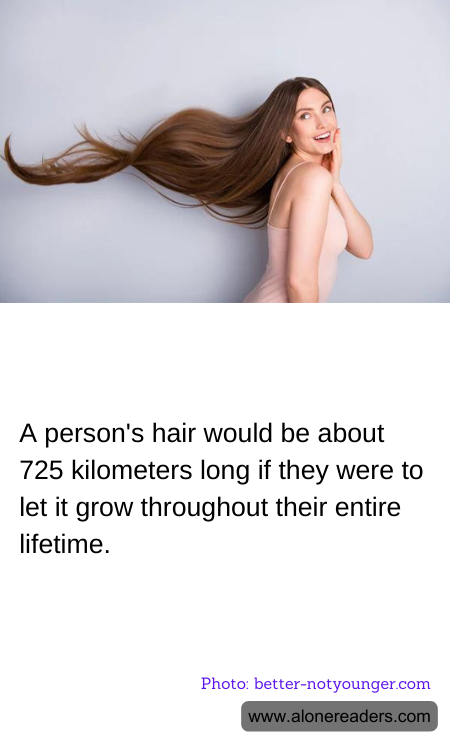
The concept of hair growing to a length of 725 kilometers over a person’s lifetime is quite striking and prompts curious exploration into the science of hair growth. Human hair grows, on average, about half an inch (approximately 1.25 centimeters) per month, which translates to about 6 inches (15 centimeters) per year. Given that the average human lifespan is around 72 years, this would mean the total length of hair growth would amount to roughly 43 feet (or about 13.1 meters) if one never cut their hair. This estimation is significantly shorter than 725 kilometers, so where does the huge discrepancy come from?
To address this, let’s delve into biological and mathematical considerations. The idea that hair could reach hundreds of kilometers in length over a lifetime is a fascinating thought experiment that would only hold under conditions varying drastically from normal human biology. Typically, each hair follicle has a growth cycle that includes growth, rest, and shedding phases. Hair does not grow indefinitely; the anagen phase (growth phase) of hair on the human head typically lasts between two and six years, not throughout a person's entire life. After this, hair enters the catagen phase (transitional phase) and eventually the telogen phase, where it falls out.
Moreover, environmental factors, genetics, nutrition, and overall health significantly influence hair growth rates and cycles. The lengths mentioned in the premise might be theoretically considered when accumulating all the hair a person loses naturally during their lifetime, but even this would be a stretch to reach the proposed 725 kilometers.
This thought experiment highlights the capacity of human hair to grow to significant lengths under continuous, uninterrupted conditions, though such scenarios are biologically and practically improbable. It underscores an interesting aspect of human biology and the limitations imposed by nature. This exploration into the hypothetical also serves as an engaging way to make general estimates about human hair growth and to reflect on the extraordinary capabilities, as well as the limitations, of the human body.