More About This Card
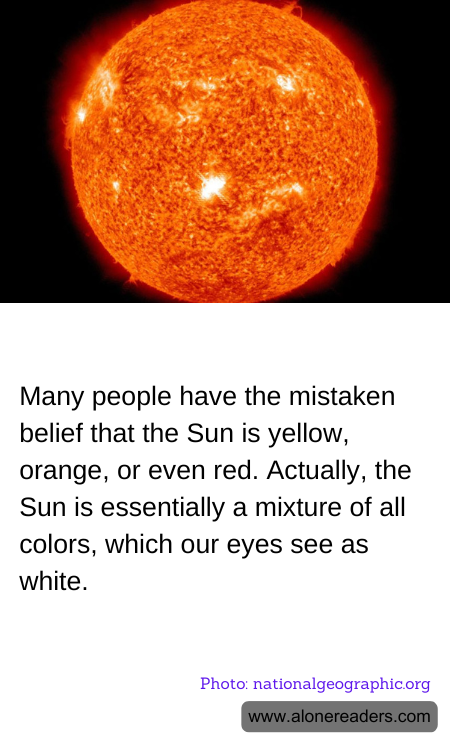
The common perception that the Sun is yellow, orange, or red is indeed a widespread misunderstanding. In reality, the Sun emits a nearly uniform spectrum of light that includes all visible colors. When combined, these colors are perceived as white by the human eye. This phenomenon is why the Sun appears yellow or even reddish when viewed from Earth's surface, and there are several fascinating reasons behind this color deception.
Firstly, the Earth's atmosphere plays a significant role in altering our perception of the Sun’s color. As sunlight enters the atmosphere, shorter wavelengths of light (blue and violet) are scattered in all directions by gases and particles in the air. This scattering, known as Rayleigh scattering, is what gives the sky its blue color during the day. The remaining sunlight that reaches our eyes is composed more of the longer wavelengths (red, orange, and yellow), thus giving the Sun a yellowish hue, particularly when it is low in the sky.
During sunrise and sunset, the Sun’s light has to pass through a greater thickness of Earth’s atmosphere compared to when it is high in the sky. More atmospheric scattering occurs, and even more of the shorter blue and violet wavelengths are removed from the direct path of the sunlight reaching an observer on the ground. What predominates in the direct sunlight during these times are the longer wavelengths, and hence the Sun can appear very distinctly orange or even red.
However, if you were to observe the Sun from space, where there is no atmosphere to scatter and filter the sunlight, the Sun would indeed appear as a pure white star. This true color of the Sun reflects its temperature, which is approximately 5,500 degrees Celsius (9,932 degrees Fahrenheit). At these temperatures, the Sun emits an electromagnetic spectrum that is closest to that of a black body radiation, which, under these conditions, produces a white color.
Understanding the true color of the Sun provides more than just trivial knowledge. It helps us gain a clearer picture of how Earth's atmosphere interacts with sunlight, influencing not only the color of the sky but also climate and weather patterns. Additionally, this knowledge is crucial for astronomers and astrophysicists in studying other stars and galaxies, offering comparisons that can lead to further insights into the universe. Thus, the Sun, while it might appear yellow to the casual observer, is actually a brilliant white star, a fact that highlights the incredible interplay between light, perception, and atmosphere.