More About This Card
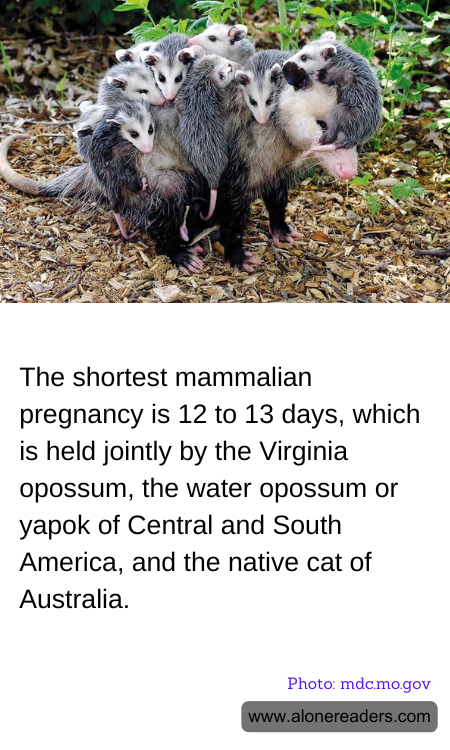
In the realm of mammalian reproduction, the lengths of pregnancy can vary dramatically, but some species are notably record-holders for the shortest gestation periods. Among these, the Virginia opossum, the water opossum (also known as the yapok) from Central and South America, and the native cat of Australia, typically experience gestation periods of merely 12 to 13 days—the shortest known among mammals.
The Virginia opossum, widely recognized for being North America's only marsupial, has a remarkably brief pregnancy. Following this short gestation period, the opossum gives birth to extremely undeveloped offspring. These tiny, embryonic-like newborns must then make an immediate journey to their mother’s pouch where they continue to develop for about two months before they can survive independently outside the pouch.
Similarly, the yapok, a lesser-known marsupial adapted to an aquatic lifestyle, shares this swift gestational trait. As a semi-aquatic creature, it has unique adaptations such as water-resistant fur and webbed hind feet, enhancing its ability to swim and forage in water. The quick maturation from conception to birth allows yapoks to reproduce quickly and more frequently, which can be beneficial in fluctuating and challenging aquatic environments.
On the other end of the geographic spectrum is the native cat of Australia, another marsupial whose rapid reproductive rate includes a similarly short gestation period. Known scientifically as Dasyurus viverrinus, this animal is better known as the Eastern quoll. Like other marsupials, after the brief pregnancy, the quoll offspring continue their development in the safety of the mother’s pouch.
This characteristic of having an extremely short pregnancy followed by an extended period of pouch maturation is typical of many marsupials. It serves an important ecological role, allowing these species to maximize reproductive efficiency. Instead of carrying a developing fetus for a long gestation period, marsupials are born in a much more embryonic state, reducing the metabolic demand on the mother during gestation but requiring a significant post-birth investment while the young are in the pouch.
Understanding such unique reproductive strategies offers insights into the diverse ways in which life has evolved to ensure survival and reproduction under different environmental conditions. The extremely short pregnancies of these mammals reflect a remarkable adaptation that highlights the broad spectrum of reproductive strategies in the animal kingdom.