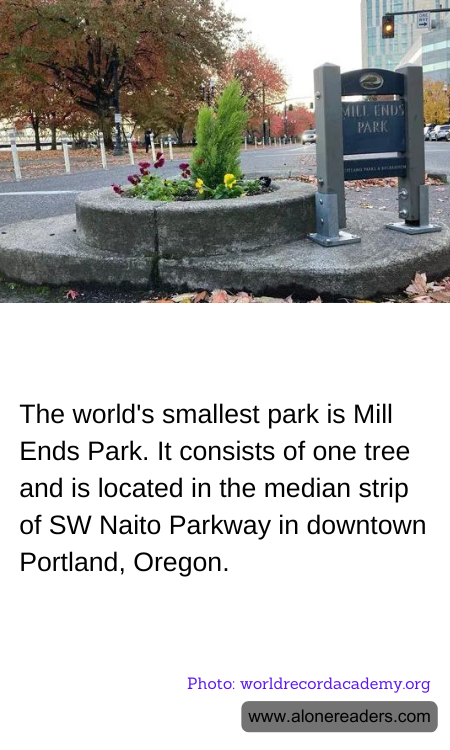
In the bustling urban landscape of Portland, Oregon lies an extraordinary and delightful anomaly that holds the record as the smallest park in the world: Mill Ends Park. This whimsical park, measuring a mere 2 feet in diameter, is strategically situated in the median strip of SW Naito Parkway in the heart of downtown Portland. The history of Mill Ends Park begins in 1948 with a local journalist named Dick Fagan, who noticed a hole meant for a light pole in the median strip outside his office window. When the light pole failed to materialize and weeds began to grow in the hole, Fagan took it upon himself to plant flowers and thereby created a tiny oasis.
What started as a simple, charming act of urban beautification quickly took on a life of its own when Fagan whimsically declared the spot Mill Ends Park, named after his newspaper column in which he often included quirky and imaginative stories. The park was officially dedicated on St. Patrick's Day in 1948 and has since become a cultural landmark. It was designated as the world’s smallest city park by the Guinness Book of World Records in 1971.
Despite its minuscule size, Mill Ends Park has hosted a variety of amusing and unusual events, including concerts for snails, a swimming pool for butterflies featuring a single thimble, and a miniature Ferris wheel which was delivered by a full-size crane. The park serves as a beacon of whimsy and a testament to the idea that creativity knows no bounds. Over the years, it has evolved from merely being a peculiar planter filled with flowers to a beloved public space that captures the imagination of visitors and locals alike.
Mill Ends Park not only adds character and charm to Portland, but it also offers a playful critique of urbanization while delivering a powerful message about community space. It demonstrates how even the smallest places can become significant through story and purpose. In today's rapidly urbanizing world, Mill Ends stands as a reminder of the importance of green spaces, no matter how tiny, and the profound impact of community-driven initiatives in nurturing urban well-being and connectivity. Its existence encourages city dwellers everywhere to rethink the potential of underused urban spaces, championing the notion that every little patch of the city can be transformed into something magical.
