More About This Card
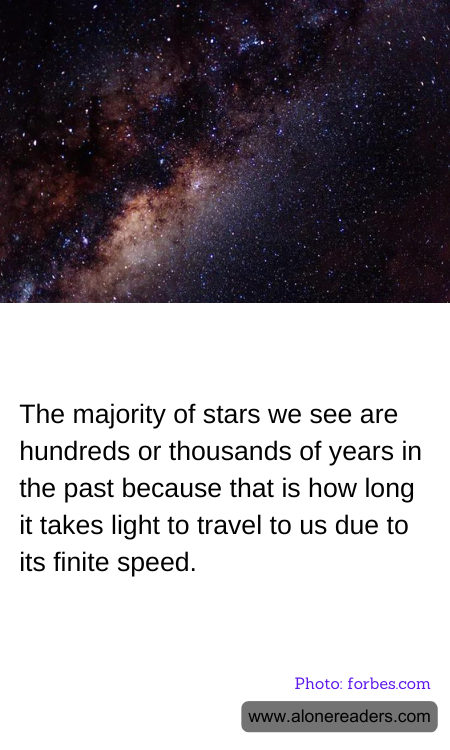
When we gaze up at the night sky, the stars we see are not in their current state. Instead, we are looking at them as they were in the past. This phenomenon occurs because of the finite speed of light. Light travels at an astounding speed of about 186,282 miles per second (approximately 299,792 kilometers per second). Despite this incredible speed, the vast distances in the universe mean that it takes years for light from stars and other celestial bodies to reach Earth.
For example, the light from our closest stellar neighbor, Proxima Centauri, takes about 4.2 years to travel to Earth. Therefore, we see Proxima Centauri not as it is today, but as it was 4.2 years ago. For stars that are thousands of light-years away, the journey is even longer. A star located 1,000 light-years away is seen as it existed 1,000 years ago because its light has taken 1,000 years to reach us. This makes observing the stars a kind of time travel, viewing the history of the universe as it unfolded.
The concept of light years also helps us to understand the scale of the universe. A light-year is the distance that light travels in one year, which is approximately 5.88 trillion miles (or about 9.46 trillion kilometers). This unit of measurement is crucial for astronomy as it helps to describe the immense distances between celestial bodies.
Moreover, when astronomers observe distant galaxies or deep space phenomena, they are looking back in time, capturing light that has been traveling possibly for millions or even billions of years. This allows them to uncover clues about the early stages of the universe, the formation of stars, and the evolution of galaxies.
Thus, the stars that twinkle and shine in our night sky serve as a living history book of the cosmos. Observing them is not only a moment of connection with the universe but also a glimpse into its vast and wondrous past. Whether it's a star a few light-years away or a galaxy billions of light-years from Earth, each point of light in the sky has its own unique, ancient story to tell.