More About This Card
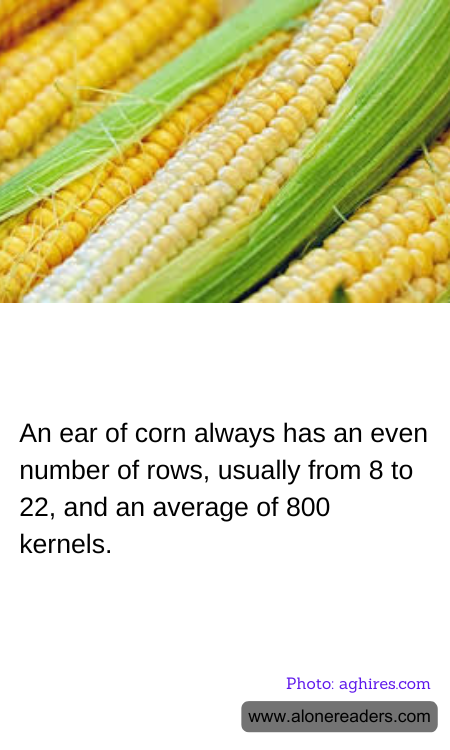
Corn, a staple grain that has been cultivated for thousands of years, has some interesting botanical features—one of which is the even number of rows that each ear of corn consistently displays. Typically ranging between 8 to 22 rows, this phenomenon can be attributed to the inherent genetics of corn growth. When a corn plant's ear develops, it forms kernels in pairs, leading to row counts that are invariably even numbers.
Each ear of corn holds an average of 800 kernels, which are arranged in a pattern of neat rows. These kernels are not just a random assemblage but result from a highly regulated biological process. During the development of an ear, pollination plays a crucial role. Each kernel results from a successful pollination event, where pollen from the tassels at the top of the corn plant must reach and fertilize the silks connected to potential kernels. This process, known as sexual reproduction in plants, ensures kernel formation and its layout into even rows.
This distinct arrangement and the even number of rows are not just fascinating quirks of nature but also enhance the structural integrity of the ear, making it more robust and easier to handle and process. Moreover, the even distribution of rows and kernels is vital for the efficient packing and transport of nutrients, facilitating better growth and development of the kernels. This feature is also incredibly beneficial for agricultural practices, as it allows for more predictable yield estimates and uniformity in crop production, essential for both small-scale farmers and large agricultural enterprises.
In essence, the symmetry seen in an ear of corn's even number of rows illustrates nature's inclination towards order and predictability, traits that are highly valued in agriculture for enhancing productivity and sustainability.