More About This Card
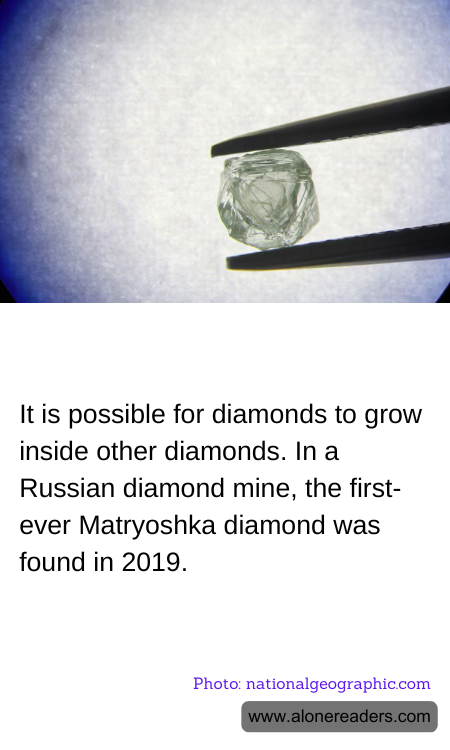
In the captivating world of gemology, the 2019 discovery of the first-ever Matryoshka diamond in Siberia's Yakutia region added a remarkable chapter. Found in a mine operated by Alrosa, Russia's leading diamond mining company, this unique diamond is a curious natural phenomenon, encapsulating a smaller diamond moving freely inside its larger counterpart. Named after the famous Russian nesting dolls, the Matryoshka diamond presents a peculiar case in diamond formation, fascinating scientists and gemologists alike.
The formation of a Matryoshka diamond, where one diamond is enveloped entirely by another, is incredibly rare. The outer diamond is believed to have formed up to 800 million years ago at depths reaching 550-700 kilometers below Earth's surface. The peculiar conditions that led to the creation of this double-diamond structure have not been found elsewhere. Inside, the smaller gem measures just over 0.02 carats, while the outer one is approximately 0.62 carats. Despite their size disparity, the existence of a freely movable diamond within another defies usual geological explanation, indicating an extremely rare sequence of diamond formation events.
This phenomenon could revolutionize our understanding of geological processes and how diamonds can form under unique conditions. Typically, diamonds form from carbon exposed to extreme heat and pressure deep within the Earth. They journey to the planet's surface through volcanic activity, ensconced in kimberlite lava. For one diamond to envelop another, however, suggests a complex and rare series of geological conditions. Such a discovery hints at the possibility of other exceptional diamond types yet to be found or understood within the vast, uncharted depths of our planet.
Researchers continue to study this find extensively, hoping to uncover more insights about the conditions that led to its formation. Alrosa's researchers speculate that the outer diamond developed in a usual diamond-growing environment, but a sudden pressure shift could have caused a small diamond crystal inside to dissolve partially. Later, as natural processes resumed, the outer diamond continued to grow, encapsulating the smaller crystal in a cavity that maintained its mobility.
The discovery of the Matryoshka diamond not only underscores the incredible complexity of natural geological processes but also enhances the mystique and allure surrounding diamonds. Each diamond tells a story of unimaginable age and a journey from the depths of the Earth, but the Matryoshka diamond, in particular, narrates a tale of extraordinary happenstance, aligning perfectly to create a singular natural marvel. As researchers delve deeper into its secrets, it stands as a dazzling reminder of nature’s capacity for beauty and complexity.