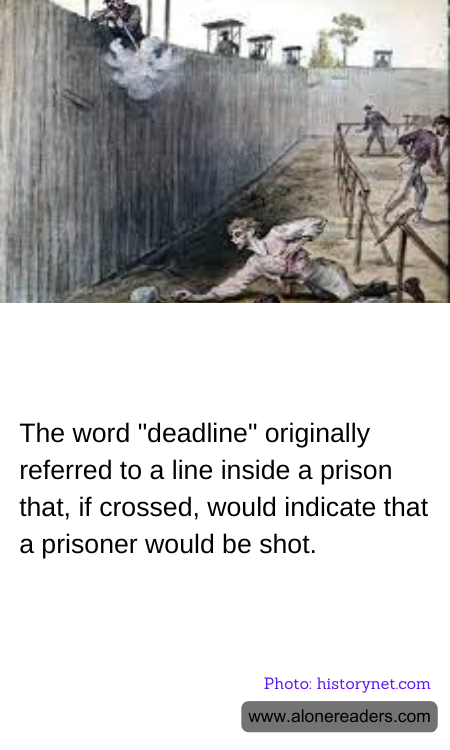
The term "deadline" is commonly used today to signify the last possible moment by which something must be completed, often stirring a sense of urgent pressure in contexts ranging from journalism to project management. However, the origins of this term are far more literal and grim than its current metaphorical use suggests.
Originally, the "deadline" was a physical boundary within prison camps during the American Civil War. These lines were drawn around the perimeter of the camp to prevent prisoners from attempting escape. The rule was harsh and clear: if a prisoner crossed this line, they would be shot by the guards without hesitation. This boundary, therefore, was quite literally a line over which if one passed, they would likely be dead. The line served both as a control mechanism and a psychological barrier, instilling a fear that kept prisoners within the limits set by their captors.
The transformation of the word from a literal line in the dirt to a metaphorical boundary came about post-war, as language evolved and the horrors of the Civil War became etched into national memory. As the industrial era brought about more structured work environments and deadlines became a necessary part of ensuring efficiency and productivity, the term began to be used to describe the latest time or date by which a task should be completed.
This evolution reflects not only a change in language but also a societal change in how we understand and manage time and tasks. Despite its violent origins, the use of "deadline" in everyday language today is far from its dark beginnings. It is an example of how words can shift dramatically in meaning and application, influenced by cultural changes and the needs of different historical moments. Thus, the next time we complain about meeting a deadline, it might be an interesting reflection to consider how the weight of this word was once far heavier.
