More About This Card
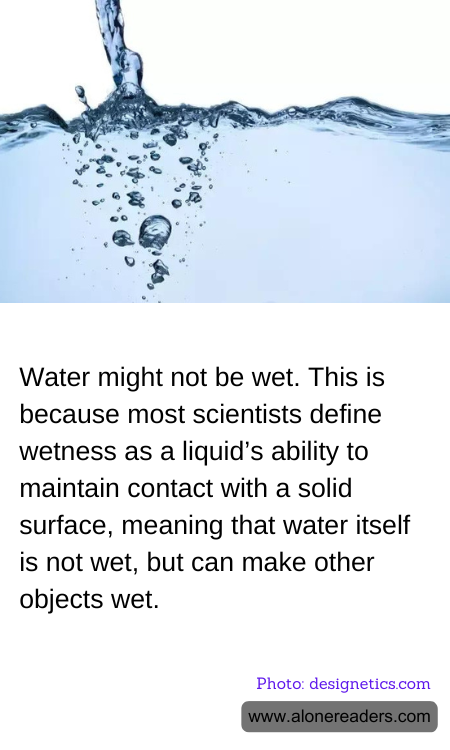
Water, often considered as the quintessential liquid and typically described as wet, isn't actually wet by itself according to scientific definitions. This concept may seem counterintuitive given our everyday experiences with water. From the feel of rain on our skin to the touch of a damp cloth, water is synonymous with wetness. However, from a scientific perspective, wetness is characterized by the condition of a liquid sticking to a solid surface, facilitated by the forces of cohesion and adhesion.
Cohesion refers to the attraction between molecules of the same substance, whereas adhesion refers to the attraction between molecules of different substances. Water, made up of molecules that attract each other, doesn’t adhere to itself in the same way it adheres to other materials. Thus, while water can make various materials wet by adhering to their surfaces and forming a thin film, the molecules within the bulk of water do not make each other wet.
When a surface is wet, what we observe is the result of adhesion — water molecules stick to the surface due to intermolecular attractions that overcome the cohesive forces within the water. This interaction leads to the spreading of water molecules in a thin layer over the surface, a hallmark of wetness. For instance, when water droplets are on a leaf, the leaf’s surface exhibits wetness due to the water molecules adhering to it. If we consider water by itself, such as a pool or droplet, there are no other materials for water molecules to stick to and form a coating; hence it is not considered wet.
This notion extends to how we perceive other liquids and their interactions. Just like water, other liquids aren't inherently wet but have the capability to wet other substances. This understanding of wetness reshapes basic concepts of what it means for something to be wet and propels further inquiries into how substances interact at molecular levels in various states of matter.
Understanding these fundamental aspects of liquids and their interactions provides greater insight into various scientific and everyday phenomena, challenging our perceptions and encouraging a deeper appreciation of the complex and fascinating behaviors of materials around us. This insight into wetness, particularly the wetness of water, is more than a semantic or philosophical question—it reflects the intricate and inherent properties of materials that define much of the physical world.