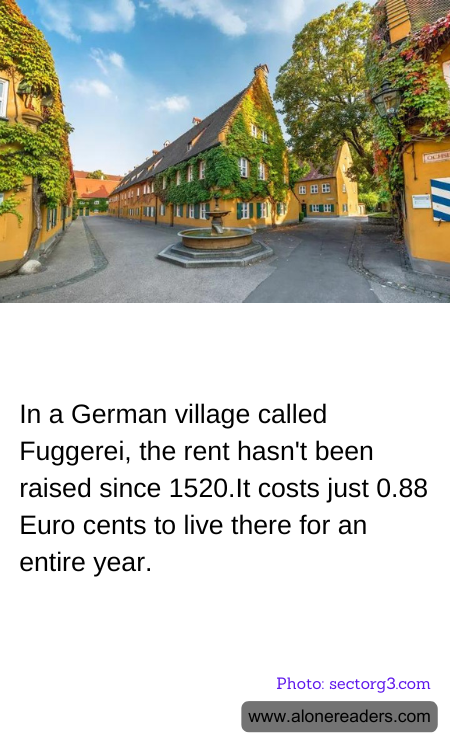
In the quaint city of Augsburg, tucked away in Bavaria, Germany, lies a unique historical artifact of social welfare: the Fuggerei. This is no ordinary housing complex; it forms a part of one of the oldest social housing projects in the world still in use. Created in 1521 by Jakob Fugger, a wealthy merchant known as Jakob the Rich, the Fuggerei was established as a benevolent gesture to provide a decent living space for the needy Catholics of Augsburg.
What stands out about this community is its incredibly low rent, which extraordinarily has remained unchanged since its inception over 500 years ago. Residents of the Fuggerei pay just 0.88 euros per year, an amount that has not increased since 1520. This nominal fee is symbolic, covering a year's rent, and underscores the founding principle of the Fuggerei — that it is meant to be a place where individuals who have fallen on hard times can find refuge and dignity without the burden of excessive living costs.
The Fuggerei itself is a walled enclave with picturesque, unchanged Renaissance architecture. It comprises 67 houses and 147 apartments, each with basic amenities. To live here, applicants must fulfill certain criteria, such as being destitute, Catholic, and a resident of Augsburg for a minimum of two years before applying. In addition to the nominal rent, residents are expected to pray three times daily for the Fugger family as a gesture of gratitude and remembrance of the founders’ charitable intentions.
Despite its age, the Fuggerei continues to serve its purpose. It operates under the stewardship of the Fugger Family Foundation, which maintains the property and ensures the legacy of its founder. The funding to maintain the buildings and the surrounding area comes from a foundation set up by Jakob Fugger, along with strategic investments and donations.
The Fuggerei is not only a residence but also a tourist attraction, inviting visitors to step back in time and experience a living piece of history. The rent collected from the tourists who visit the walled enclave helps in the upkeep and preservation of this historic site.
In a world where housing costs are on a relentless upsurge, the Fuggerei stands as a testament to the enduring power of community spirit and charity. It reminds us of the potential for humanity to support its vulnerable populations, by balancing tradition with the pressing needs of modern life.
