More About This Card
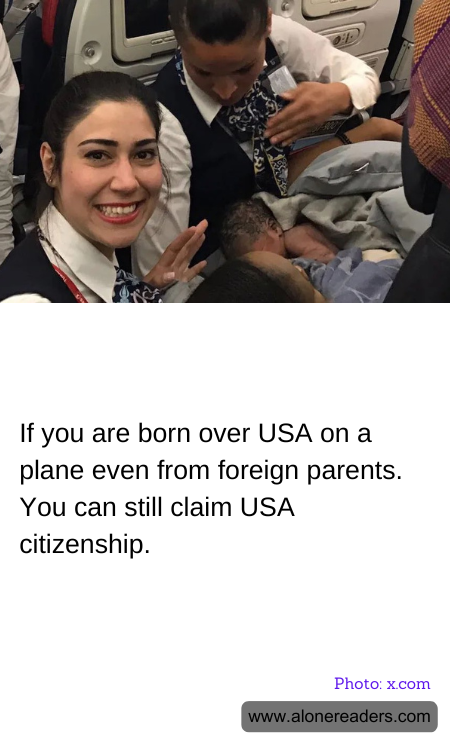
The concept of birthright citizenship in the United States holds that anyone born on U.S. soil is automatically granted U.S. citizenship. This principle stems from the 14th Amendment to the Constitution, which states that all persons born or naturalized in the United States and subject to the jurisdiction thereof are citizens of the United States and of the State wherein they reside. However, the situation becomes more complex when a child is born in the airspace of the United States to foreign parents on an international flight.
According to U.S. nationality law, and specifically the Immigration and Nationality Act (INA), a person born in an aircraft flying over the United States is generally considered to have been born "in the United States," and therefore could be a U.S. citizen by birth, under the principle of jus soli, which is the right of the soil. However, this determination can be subject to the interpretation of certain legal nuances. The key determinant is whether the birth occurred in U.S. airspace or was merely flying over international waters at the time of birth, in which case U.S. citizenship may not automatically be conferred.
Additionally, the location of the aircraft – whether it is in U.S. airspace – is also crucial. Births on aircraft flying over international waters do not qualify for U.S. citizenship based on place of birth. Therefore, the specifics of the flight path at the time of birth matter significantly. Generally, the rule applies that if the birth happens within U.S. airspace, the rights and privileges of U.S. citizenship are afforded to the child, but if the birth occurs in international airspace, the child would assume the nationality of the country in which the airline is registered, or the nationality of the parents could play a role.
It's important for parents in such situations to consult legal authorities or immigration experts to understand the implications of the specific circumstances of the birth. This can include verifying the exact location of the aircraft at the time of the child’s birth and understanding the nationality laws of the parents' native country or countries. Many nuances and international laws can influence the final determination of citizenship for a child born under such unique circumstances.
In summary, while a child born to foreign parents on a plane flying over the United States could potentially claim U.S. citizenship, the outcome depends on specific factors including the location of the aircraft at the time of birth. Verification and legal consultation are recommended for parents in this situation to ensure that their child’s nationality and citizenship rights are clearly understood and appropriately documented.