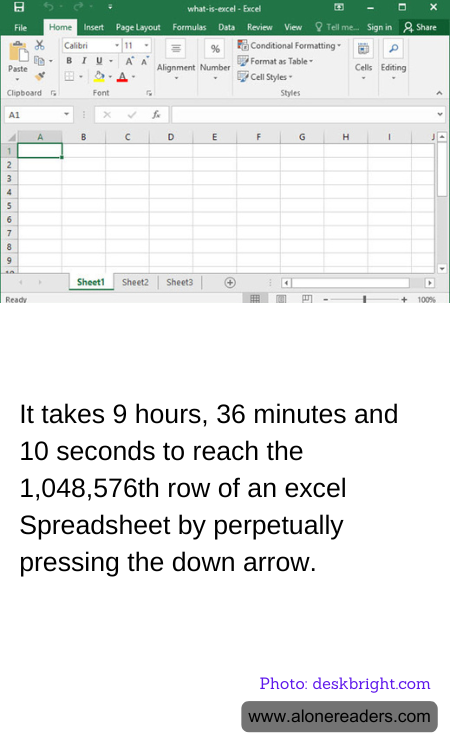
Embarking on a quest to reach the 1,048,576th row of an Excel spreadsheet by continuously pressing the down arrow key seems like an arduous, if not bizarre, journey. Yet, it unfolds mysteries about patience, the mechanics of software, and perhaps a touch of human curiosity about limits. Believe it or not, it takes approximately 9 hours, 36 minutes, and 10 seconds to complete this task—a testament to the vastness embedded within our everyday tools.
Microsoft Excel, a staple in data manipulation and analysis, caps its rows at exactly 1,048,576. This seemingly arbitrary number is far from random; it is 2^20, reflecting a binary system of counting—a core principle in computer science. This limit ensures a balance between adequate capacity for most users and manageable system performance.
Reaching the last row by holding down the arrow key is a slow journey, largely due to the program's response time and the refresh rate of most computer screens. With each press or hold of the key, Excel moves to the next row, updating the entire screen each time. Depending on your computer's processing power, the visual rendering can lag slightly behind the actual position in the spreadsheet, adding considerable time to seemingly simple tasks.
The effort to reach row 1,048,576 in such a mechanical, manual way might sound needless, given the various shortcuts Excel provides—like pressing Ctrl+Down Arrow which instantly jumps to the next available blank row, or simply typing the row number in the name box. So why consider undertaking such a journey by hand?
The answer is equally about human curiosity and the exploration of the mundane's limits. What happens when we push everyday software to its boundaries? We learn not only about the tool's capacities and built-in efficiencies but also about our perceptions of time and patience. For anyone actually counting, holding down the arrow key to scroll through over a million rows allows for an introspection about time, technology, and perhaps a bit of digital absurdity.
In the age of automation and shortcuts, choosing the longest route is a reminder of the massive scale and capabilities that lurk within common software applications, waiting to be acknowledged or maybe just stumbled upon during a deep dive. While not practical, reaching the final row of an Excel spreadsheet in this manner is a peculiar journey through the digital expanse of rows and columns, and a challenge to the human spirit's peculiar fascination with what lies at the end of the line.
