More About This Card
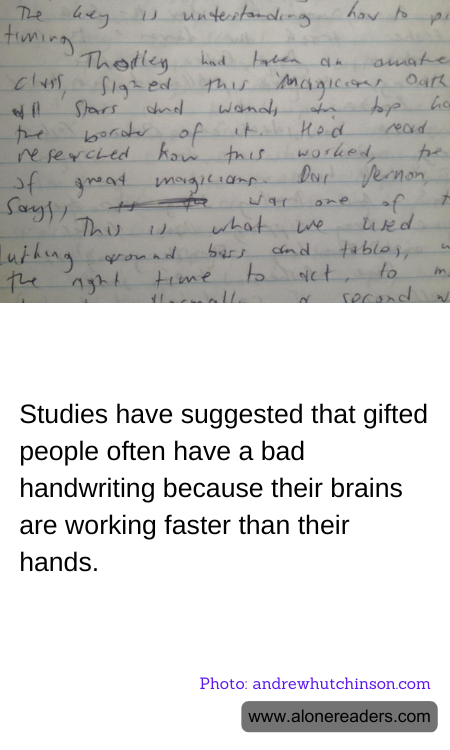
The notion that gifted individuals typically possess poor handwriting due to the rapid processing capabilities of their brains is an intriguing hypothesis that merits closer scrutiny. Gifted people are often characterized by their ability to think quickly, analyze situations, and come up with solutions faster than others. This quick-thinking ability, while advantageous in intellectual and creative pursuits, might have unexpected consequences in more mundane tasks such as handwriting.
When someone is thinking fast, their hand may struggle to keep pace with the thoughts as they form. This is particularly evident in situations where the person is trying to write down ideas as swiftly as they occur. The disconnect between the speed of cognitive processing and the physical act of writing can result in handwriting that appears rushed, sloppy, or even illegible. Thus, the handwriting of a gifted individual might reflect the haste and flurry of their thoughts rather than a lack of dexterity or care in penmanship.
Moreover, gifted individuals often excel in areas that prioritize cognitive development over motor skills, such as in theoretical physics or abstract mathematics, where the emphasis is more on problem-solving and less on manual tasks. For such individuals, fine motor skills that influence handwriting might be less developed compared to their exceptional cognitive abilities. This could also contribute to poorer handwriting, as their educational and professional environments may not stress the importance of neat or careful handwriting as much as intellectual rigor.
Additionally, there is a psychological aspect to consider. Gifted individuals might experience boredom or frustration from the slow pace of standard or repetitive tasks such as writing. This lack of engagement could result in a lack of motivation to improve handwriting or the development of a hurried script as a way to quickly transition to more stimulating activities.
However, it's important to note that while some studies and observations suggest a link between high cognitive processing speed and poor handwriting among gifted individuals, more comprehensive research is needed to conclusively determine the correlation. Factors such as left-handedness, dysgraphia, or other learning disabilities can also play significant roles in handwriting quality and should be considered when examining the handwriting of gifted individuals.
In conclusion, while the hypothesis that gifted people have bad handwriting because their brains operate faster than their hands is fascinating and has some anecdotal and theoretical support, it remains a generalization that might not apply universally to all gifted individuals. Handwriting is influenced by a variety of cognitive, physical, and psychological factors, and while rapid thought processes might impact handwriting quality in some cases, this trait should not be viewed as a definitive marker of giftedness.