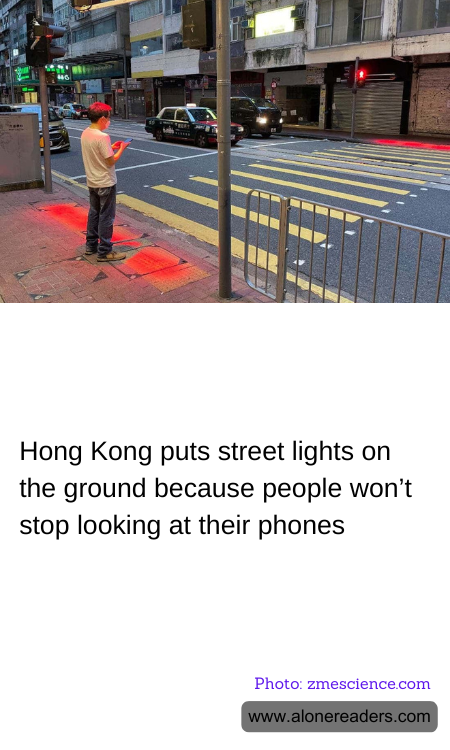
In the bustling city of Hong Kong, an innovative measure has been introduced to ensure the safety of pedestrians glued to their mobile screens. The city has started installing street lights on the ground, a solution aimed at preventing accidents caused by the distraction of smartphones. This initiative reflects the growing concern over "smartphone zombies" or people who walk while engrossed in their phones, often disregarding their surroundings.
The phenomenon of pedestrians being absorbed in their devices has escalated with the proliferation of social media, streaming services, and the constant bombardment of notifications. Traditional streetlights and traffic signals often fall outside the line of sight of someone staring down at a screen, increasing the likelihood of accidents. By installing street lights at ground level, Hong Kong authorities hope to catch the eye of distracted walkers, pulling their attention back to their environment just long enough to keep them safe as they cross streets.
These ground lights are designed to sync with regular traffic signals, changing colors congruently with pedestrian and traffic lights. When the standard traffic light turns green, the ground-level lights do the same, and similarly turn red. They provide a straightforward, intuitive guide for pedestrians, ensuring they are aware of their crossing status without needing to look up from their phones.
While some argue that this measure might further encourage people to keep their eyes on their mobile devices, others believe it's a necessary adaptation to an irreversible change in behavior. It's an acknowledgment that public safety interventions must evolve alongside technological advancements and changing human behaviors.
Moreover, the adaptation is part of a broader smart city initiative that Hong Kong is embracing. This includes the use of technology to enhance urban living and safety. The use of ground-level lights is also being evaluated for effectiveness and could potentially be expanded if proven successful. As cities around the world confront similar challenges, innovations like these offer insights into how urban spaces can be made safer and more navigable for technologically engaged citizens.
This approach does not just highlight a local solution but underscores a global need to rethink traditional urban safety measures. As dependence on smartphones continues to grow, other cities might look to Hong Kong's example as a practical way to adapt to the digital age, ensuring pedestrian safety in a world where attention is increasingly divided.
