More About This Card
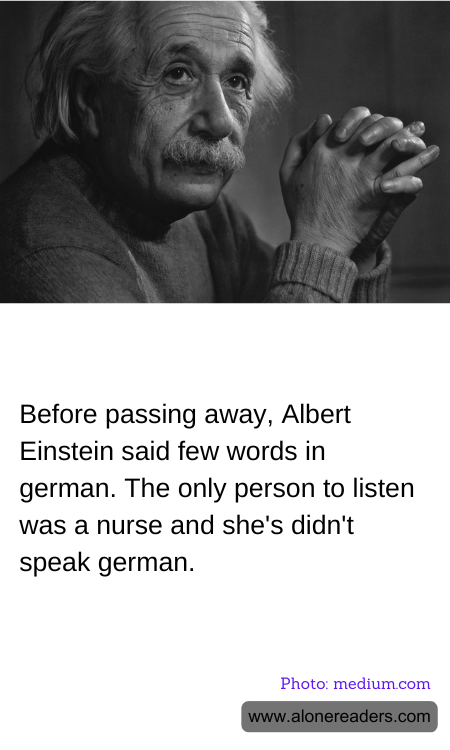
Albert Einstein, one of the most celebrated physicists of all time, is known for his profound contributions to science, particularly with his theory of relativity. However, his final moments are remembered not just for their poignancy but also for the enigmatic nature of his last words. Before passing away on April 18, 1955, Einstein uttered a few words in German. Tragically, these words were lost to posterity because the person by his side, a nurse, did not understand German and thus could not recall his last statement.
The incident remains a source of curiosity and mystery. What might Einstein have said? Was it a succinct summary of a scientific insight? A reflection on his life’s work or personal regrets? Or perhaps a message he intended for his family or friends? The ambiguity surrounding his final words only adds to the mystique surrounding a man who had spent a lifetime unraveling the mysteries of the universe.
This narrative also serves as a poignant reminder of the impermanence and limitations of human experience—the unknowns not just in advanced theoretical physics but in our personal, everyday interactions. Just as light from distant stars might be obscured or altered by interstellar clouds, so too can the meaning in a sentence vanish in the air if there is no one to understand it. In this way, Einstein's last moments are a reflection of his work: something potentially profound was articulated, but without a capable observer, its significance was irrevocably lost.
The story might also reflect on the sometimes solitary nature of genius. Einstein's groundbreaking insights often set him apart from his peers, pushing the boundaries of what was accepted and understood. In his final moments, the lack of a common language between him and the nurse highlights a solitude that often accompanies those who operate on the intellectual margins.
Einstein’s lost words compel us to think about legacy and communication. They remind us that history is often a construction, made as much of what we know as what we forever speculate upon. They tease us with their mystery and encourage a sense of humility—reminding us that even great minds like Einstein face moments of profound human simplicity and fragility.