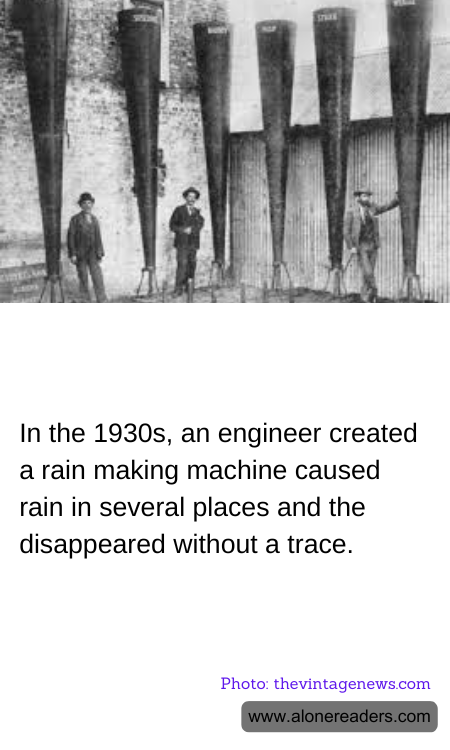
In the 1930s, during an era enchanted by the possibilities of technological advancements, an engineer named Charles Hatfield made headlines with what he claimed to be a rainmaking machine. Hatfield, who styled himself as a "moisture accelerator" specialist, came into prominence when he offered his rain-producing services to drought-stricken communities.
The concept of rainmaking at the time was entwined with both genuine scientific curiosity and a fringe form of showmanship. Hatfield's method, which he somewhat secretively referred to as using a mixture of chemicals, was to be burned in large evaporating towers, thereby producing smoke and fumes which were supposed to ascend and condense in the clouds, catalyzing rainfall. He asserted that his concoctions were capable of coaxing clouds to produce precipitation.
Charles Hatfield's most famous incident occurred in 1916 when he was hired by the city of San Diego. The city, suffering from a devastating drought, was desperate for water. Hatfield promised to fill the Morena Dam reservoir in exchange for $10,000, asserting his confidence in his invention. Remarkably, after Hatfield set up his apparatus and began his chemical incantations, it began to rain substantially, leading to what is known as the San Diego flood of 1916. The torrential downpours led to severe flooding, causing significant damage and resulting in the loss of lives.
Despite the catastrophic results, the debates around Hatfield's role in the actual generation of rain persisted. Was it a mere coincidence, or had Hatfield truly found a method to influence weather patterns? The scientific community remained skeptical of Hatfield’s claims, mostly attributing his successes to well-timed natural occurrences rather than the efficacy of his machine. Afterward, due to the disaster in San Diego, along with increasing skepticism, Hatfield's popularity waned, and his 'rainmaking' practices were gradually regarded more as pseudoscience than a technological breakthrough.
Eventually, as the modern understanding of meteorology advanced, the plausibility of such a rainmaking machine was largely discredited. Charles Hatfield's story remains an interesting anecdote in the history of human attempts to control nature. His invention, cloaked in secrecy and showmanship, vanished just as mysteriously as it had appeared, leaving behind a legacy that mixes myth with meteorology. This tale is a poignant reminder of humanity's perennial quest to harness the powers of nature, often blurring the lines between science and the mystical.
