More About This Card
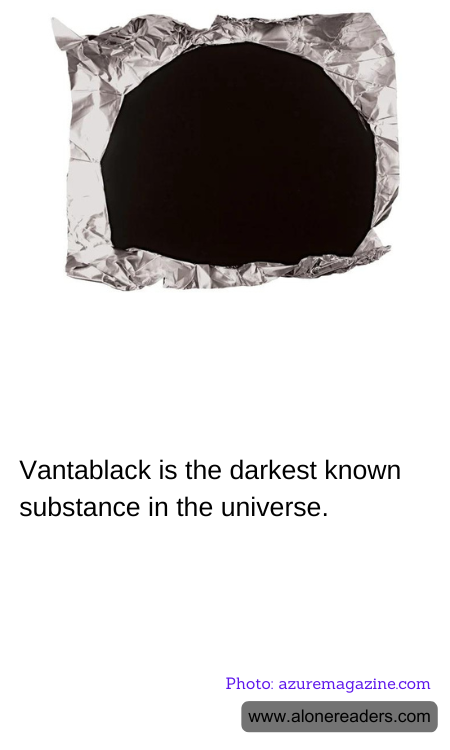
Vantablack has captured widespread attention not only for its intense color but for its remarkable scientific applications and implications. Made by Surrey NanoSystems in the United Kingdom, Vantablack is one of the darkest substances known, capable of absorbing up to 99.965% of visible light. The name stands for “Vertically Aligned NanoTube Arrays” and its darkness is attributed to a forest of carbon nanotubes. These tiny tubes are so tightly packed that light particles entering them cannot escape, effectively getting trapped and absorbed.
The creation of Vantablack marked a significant breakthrough in material science, offering a new range of extraordinary potential. Beyond its striking appearance and aesthetic uses, such as in artistic projects and architectural features, Vantablack has practical applications that are even more fascinating. In the field of astronomy, its light-absorbing properties help minimize stray light, making it an excellent lining for telescopes used to observe distant stars and galaxies. This enhances the sensitivity of telescopes and allows astronomers to see farther into space with greater accuracy.
Another significant application of Vantablack is in the defense and stealth technology sector. Its ability to absorb light and radar waves can be used to make stealth aircraft and other equipment less detectable. Additionally, the material's thermal properties can help disguise the heat signatures of various military technologies.
The fascinating properties of Vantablack extend into the scientific domain as well. Researchers are exploring its use in solar power technology, as its ability to absorb light efficiently could potentially increase the efficiency of solar panels. Moreover, this material could be used in thermal cameras and other optical equipment, improving the accuracy and efficiency of these devices.
Despite its numerous applications, working with Vantablack requires careful handling due to its composition and the complexity of its production process. Its delicate nature means it can be damaged by direct contact, and it requires a specialized environment for application and curing. This makes Vantablack an expensive product, limiting its accessibility and widespread use.
As research and technology advance, potential new applications and methods to address the challenges associated with Vantablack may appear. This ultra-black material not only continues to thrill the scientific community but also sparks the imagination of various industries and artists, poised to redefine the limits of what materials can achieve in technology and design.