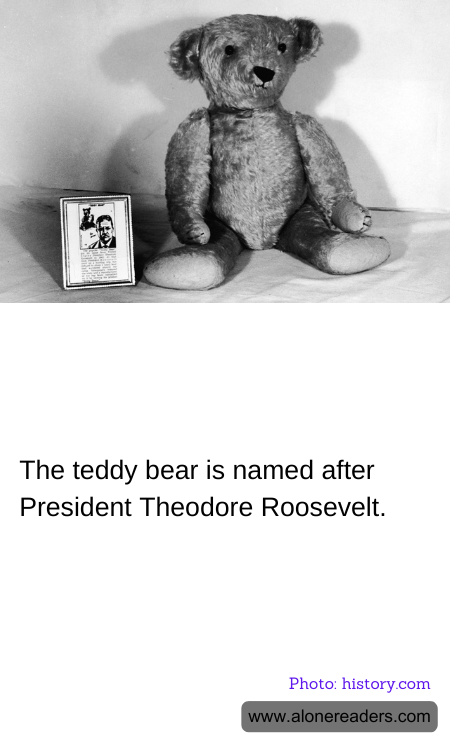
The teddy bear, a beloved children's toy familiar across the globe, carries a rich history that dates back to the early 20th century and significantly connects to American President Theodore "Teddy" Roosevelt. The story of how the teddy bear got its name is both interesting and bizarre, involving a hunting trip and a political cartoon which together sparked a global phenomenon.
In November 1902, President Roosevelt participated in a bear hunting trip in Mississippi. During this excursion, the other members of the hunting party managed to capture an American black bear after a long, exhausting pursuit. In an act of sportsmanship, Roosevelt felt it would be unsportmanlike to shoot the bear they had tied to a tree to give him the opportunity for an easy trophy; he deemed this inhumane and ordered the bear to be killed to put it out of its misery rather than shooting it himself for sport. This event made headlines and was soon captured in a whimsical drawing by political cartoonist Clifford K. Berryman in The Washington Post. The cartoon depicted Roosevelt with his hand raised in refusal to shoot the restrained and defenseless bear, which Berryman had exaggerated to a cute, shy and baby-like creature.
Inspired by this cartoon, Morris Michtom—a shopkeeper in Brooklyn, New York—saw an opportunity. He created a small, soft, plush stuffed bear and displayed it in his shop window, labeling it "Teddy's bear," with the permission of Roosevelt who was reportedly amused by the idea. The creation of this bear doll quickly captured the public's heart, opening the floodgates to an overwhelming demand. Seeing the success, Michtom founded the Ideal Novelty and Toy Co., which would become one of the largest toy companies in the United States.
Parallel to Michtom's efforts, the Steiff firm in Germany, unbeknownst to the Roosevelt story, had been producing stuffed animals for years and started selling teddy bears in Europe around the same time after Margarete Steiff's nephew Richard designed a bear prototype, which was then showcased at the Leipzig Toy Fair in 1903. American businessmen saw the German teddy bears and were immediately captivated, leading to mass production and the spread of teddy bears worldwide.
Thus, this humble origin tied to an act of compassion by President Roosevelt unexpectedly sprouted a lasting symbol of comfort and childhood. Today, the teddy bear is not merely a toy but serves as a tool for therapists, a staple in children's hospitals, and a comforting presence in homes around the world. This story of the teddy bear beautifully illustrates how a simple act of kindness can evolve into a legacy, enduring in the hearts of both the young and the old.
