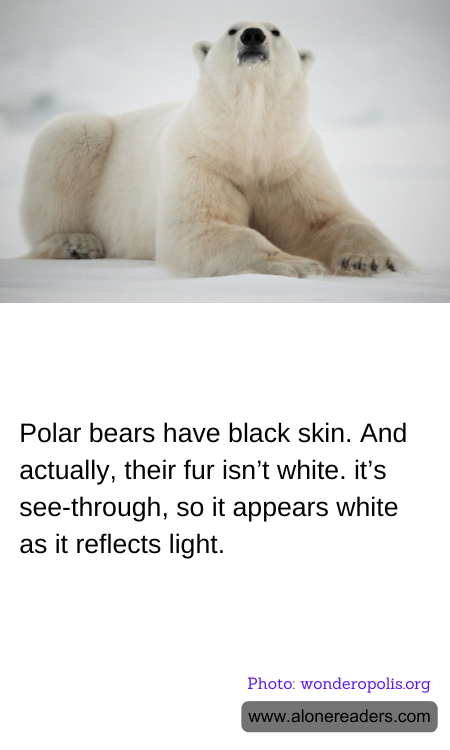
Polar bears, often perceived as quintessential symbols of the Arctic's pristine whiteness, harbor some surprising secrets beneath their seemingly snowy coats. Remarkably adapted to their frigid habitat, these majestic creatures have black skin—a stark contrast to their usual portrayal. This dark complexion plays a critical role in their survival in the harsh polar climate, as it efficiently absorbs and retains heat from the sun, a vital feature in their predominantly ice-cold environment.
Adding to their unique characteristics, polar bears' fur, which appears white and enables them to blend seamlessly into their snowy surroundings, is actually not white at all. Each strand of a polar bear’s fur is transparent with a hollow core. When light strikes their fur, it becomes scattered and diffused along the hollow segments of each hair strand. This process of scattering light gives the fur its white appearance, a perfect example of nature's camouflage at work. This transparent fur not only helps with insulation, keeping the bears warm by trapping heat, but also camouflages them against the stark white of ice and snow, an essential feature for hunting seals, their primary prey.
The reflective quality of polar bear fur is so effective that it can sometimes lead them to appear almost invisible under infrared photography, which detects heat rather than light. Despite the thick layer of fur, the bears’ black skin absorbs heat that passes through the fur, ensuring that they retain warmth.
These remarkable adaptations highlight the intricate balance of evolutionary traits that enable polar bears to thrive in one of the Earth's most extreme environments. Moreover, understanding these features not only fascinates those interested in the natural world but also underscores the importance of preserving such specialized habitats from threats like climate change and Arctic ice melt. This knowledge compels a greater responsibility towards environmental stewardship to ensure the survival of these remarkable animals in their native landscapes.
