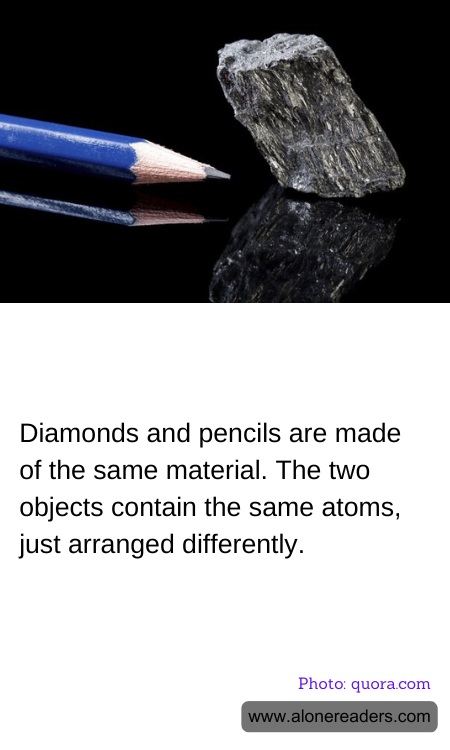
Diamonds and pencils share a common element—carbon—but their differing physical properties stem from how this carbon is configured at the atomic level. In diamonds, the carbon atoms are arranged in a rigid crystal lattice that gives them a three-dimensional structure known as a tetrahedral configuration. This arrangement is what lends diamonds their extraordinary toughness and characteristic brilliance, as the configuration allows for a high degree of light refraction. The strong covalent bonds between the carbon atoms in each tetrahedron extend throughout the crystal, making diamonds the hardest known natural material.
Pencils, on the other hand, are composed primarily of graphite, another form of carbon. In graphite, carbon atoms are organized in layers of hexagonal lattices. These layers, unlike the tetrahedral structure of diamonds, are only loosely bonded to one another by weak van der Waals forces, allowing them to slide over one another easily. This property is what makes graphite an excellent material for writing, as it can leave marks on paper due to these layers sloughing off onto the page under the friction of writing.
This remarkable diversity in properties, attributed to differences in atomic arrangements, highlights the versatility of carbon. Both diamonds and graphite serve as compelling demonstrations of how the arrangement of atoms can dramatically alter the characteristics and applications of a material. Understanding this has vast implications, influencing everything from industrial tool manufacturing to the production of writing instruments, and even extending into the realm of nanotechnology where researchers explore other potential forms of carbon like graphene and fullerenes, each with its own unique set of properties and uses.
Thus, the commonplace pencil and the exquisite diamond serve as a fascinating testament to the complexity and potential of the materials derived from basic chemical elements. They underscore the importance of both atomic structure and molecular bonding in determining the physical properties of materials, offering valuable insights into both the world of advanced materials science and everyday objects.
