More About This Card
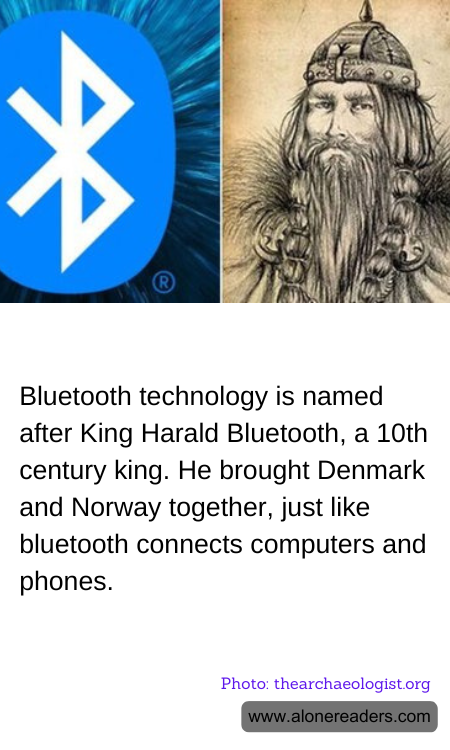
Bluetooth technology, ubiquitous for its role in wirelessly connecting devices like computers, headphones, and mobile phones, is intriguingly named after an ancient Scandinavian ruler, King Harald Bluetooth. This 10th century king was renowned not just for his leadership but also for his efforts in unifying Denmark and Norway. Much like King Harald who brought together diverse regions, Bluetooth technology connects disparate devices, facilitating seamless communication across various platforms.
In the 1990s as the need for a robust wireless communication standard was becoming increasingly apparent, Jim Kardach, an engineer at Intel, was inspired by the historical figure of King Harald. The king's abilities to integrate and unite contrasting factions and regions symbolized the aspirations behind this new technology. In conceiving a prototype, Kardach was reading a book on Viking history, which highlighted Harald's successes in unification. Finding a parallel between Harald's accomplishments and the technology’s goal to synchronize different devices and protocols, he adopted the name Bluetooth as a temporary codename for the project. This provisional name eventually became the official label for the now-ubiquitous standard.
Bluetooth technology uses a short-range wireless communication protocol to link multiple devices over a short distance, effectively replacing the traditional cables that used to clutter our work and living spaces. By allowing devices to communicate with each other without direct human intervention, it supports a wide range of applications from transferring files and managing audio transmissions to broadcasting advertisements and more.
Today, Bluetooth technology is embedded in billions of devices worldwide, marking its significance not just in consumer electronics but in industries as varied as healthcare, automotive, and home automation. In essence, by fostering integration and connectivity, Bluetooth has lived up to the legacy of its namesake, King Harald, by bridging gaps between the digital islands in our daily lives.